
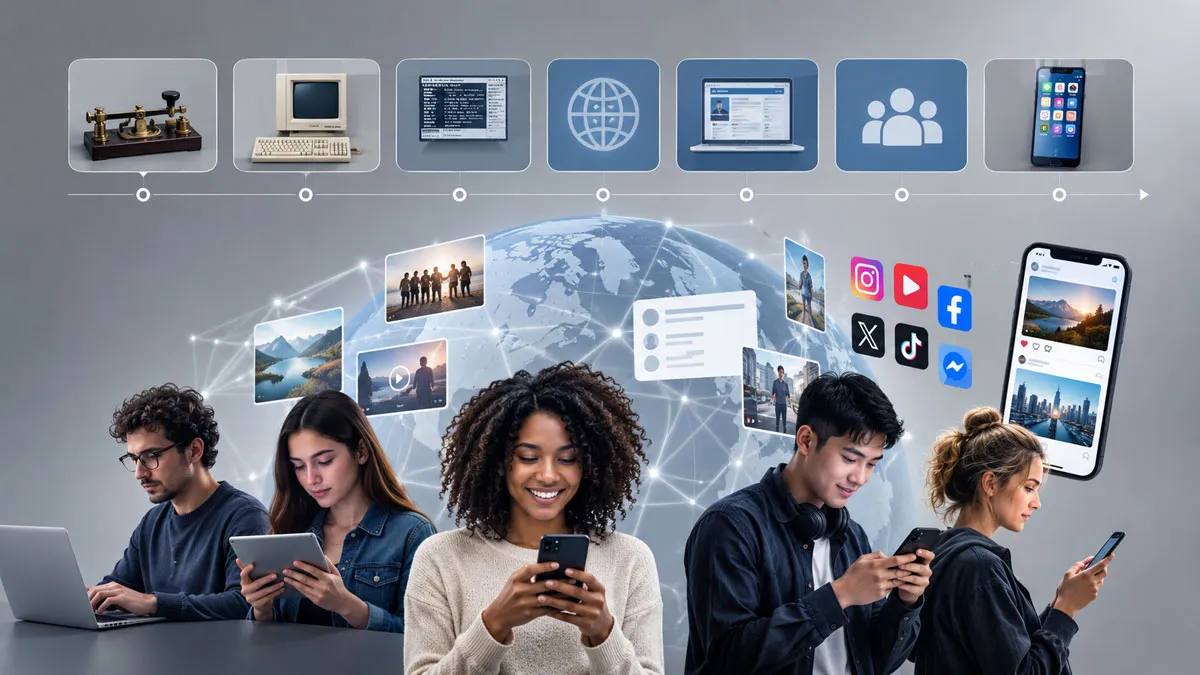
Social media did not appear suddenly with the arrival of modern smartphone apps. Its development grew from a much longer history of electronic communication, online communities, and increasingly interactive forms of the internet. Early computer networks allowed people to exchange messages and files, while later web technologies made it possible for ordinary users to publish, respond to, and share on a much larger scale.
Understanding this history helps explain why social media became such an important part of modern communication. Its evolution reflects a broader shift from communication controlled mainly by institutions toward an environment in which users can create, distribute, and interact with themselves.
Early Foundations Of Online Social Communication
The roots of social media extend beyond websites commonly described as social networks. Electronic communication had already begun changing social interaction through technologies such as the telegraph. Later, computer networks introduced new ways for people to communicate without being physically together.
One important development was the creation of ARPANET, a pioneering computer network that connected research institutions. As network technology developed, electronic mail became an increasingly practical way for people to communicate across distances. These systems did not resemble today’s social platforms, but they established an essential principle: computers could connect people as well as information.
During the 1980s, bulletin board systems, commonly known as BBSs, provided another important step. Users could connect to a host computer through telephone networks to exchange messages, share files, participate in discussions, and play text-based games. Because connections were often local and relatively slow, these communities were limited compared with later internet platforms, but they introduced many characteristics associated with online social interaction.
From The Early Web To Interactive Communities
The World Wide Web expanded public access to networked information during the 1990s. Early websites were generally more static: visitors primarily consumed information rather than continuously contributing to it. The later development commonly described as Web 2.0 changed this relationship by emphasizing participation and user-generated .
Blogs, forums, wikis, photo-sharing services, and other interactive websites gave people increasingly simple ways to publish material and respond to other users. The distinction between producer and audience consequently became less rigid.
This transition was fundamental to social media because the technology was no longer being used only to retrieve information. People could create communities, maintain relationships, publish their own material, and participate in ongoing conversations.
The Shift Toward User-Generated
Several characteristics helped distinguish emerging social media from earlier forms of online communication:
- Users could create and publish their own .
- People could interact publicly or privately with other users.
- Online communities could form around shared interests rather than physical location.
- could be distributed rapidly across interconnected networks.
These features reduced some of the traditional barriers to publishing. A person no longer needed access to a newspaper, television station, or professional publishing organization to communicate with a potentially large audience.
The Rise Of Social Networking Platforms
The early 2000s marked a major stage in the development of social networking. Platforms began to organize online relationships around identifiable personal profiles, connections, messages, and shared .
Facebook, launched in 2004, began as a networking service for Harvard students before expanding beyond its original university audience. YouTube followed in 2005, giving users a dedicated platform for sharing video. Reddit also began in 2005, combining user-submitted with community discussion and voting. Instagram arrived in 2010 with a strong emphasis on photographs and videos.
The emergence of these services demonstrated that social media was becoming more than a collection of online discussion spaces. Platforms could support large communities while specializing in different forms of communication and .
Important Stages In The Development Of Social Media
| Period | Development | Significance |
|---|---|---|
| 1960s–1970s | Early computer networking and electronic communication | Established the technical foundations for networked interaction. |
| 1980s | Bulletin board systems and online communities | Enabled users to exchange messages, files, and discussions through connected computers. |
| 1990s | Growth of the public internet and World Wide Web | Made online information and communication increasingly accessible. |
| Early 2000s | Web 2.0 and social networking | Expanded user participation and user-generated . |
| 2010s | Mobile and visual social platforms | Made social interaction increasingly immediate and centered on smartphones. |
How Mobile Technology Changed Social Media
The spread of smartphones changed the relationship between people and social platforms. Earlier internet use often depended on a desktop computer, a modem, or another fixed connection. Mobile devices allowed users to create and consume from many locations throughout the day.
Social media consequently became increasingly visual, immediate, and continuous. Photographs, short videos, messages, and other forms of could be created and shared without returning to a desktop computer.
This mobile environment also encouraged platforms to emphasize highly accessible formats. Social interaction became integrated with everyday activities rather than remaining a distinct activity performed at a computer.
From Social Networks To Large-Scale Digital Communities
As platforms grew, social media became a broad category rather than a single type of service. Social networking, video sharing, blogging, discussion communities, professional networking, and other forms of digital interaction became part of the wider social media environment.
The scale of participation also changed the nature of communication. Traditional mass media generally relied on professional organizations to select and distribute . Social media lowered the barriers to publication, allowing individuals and smaller communities to reach audiences directly.
This development created new opportunities for people to communicate across geographic boundaries. Individuals could maintain relationships over long distances, find communities based on shared interests, and participate in conversations that might previously have been difficult to access.
The Broader Impact Of Social Media
The historical development of social media has affected communication, culture, education, business, entertainment, and public discussion. Digital communities can help people exchange knowledge and maintain relationships, while organizations can communicate directly with audiences without relying entirely on traditional media channels.
At the same time, the same characteristics that make social media powerful create challenges. can spread rapidly without the editorial processes traditionally associated with professional publishing. Misinformation can therefore circulate quickly, while algorithmic systems can influence which material users encounter. Social media has also contributed to new forms of social interaction in which online identities and communities become significant parts of everyday life.
These effects do not make social media inherently beneficial or harmful. They demonstrate that its consequences depend partly on how technologies are designed, how platforms are used, and how individuals and communities respond to the information they encounter.
Why The History Of Social Media Matters
The history of social media is ultimately a history of changing communication. The progression from early electronic messaging to bulletin boards, the World Wide Web, interactive platforms, and mobile applications reflects a gradual reduction in the distance between people and the means of publishing information.
What began with relatively limited computer networks developed into a global environment in which communication can be immediate, interactive, and participatory. The most important historical change is therefore not simply the appearance of particular platforms. It is the transformation of ordinary users from primarily recipients of information into active participants in its creation and distribution.
Social media continues to reflect this broader evolution of digital communication: technology changes, platforms come and go, but the underlying desire to communicate, form communities, share experiences, and exchange information remains a consistent part of human society.