
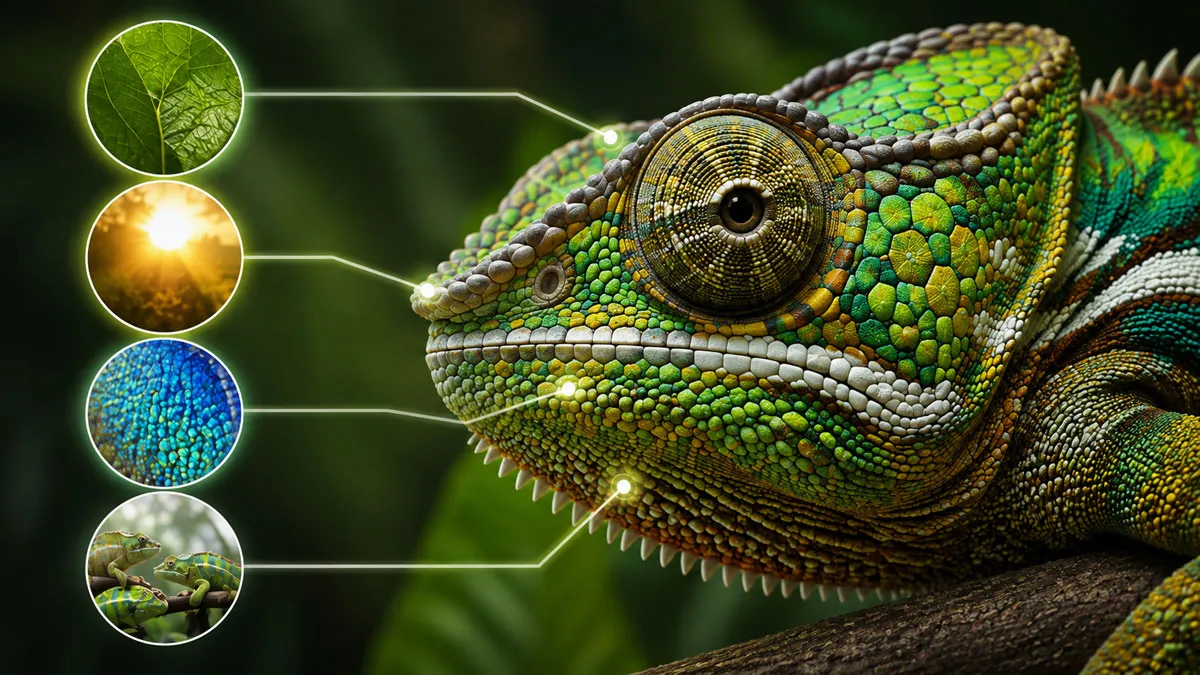
The remarkable color changes of chameleons are controlled by specialized structures in their skin and are used for several purposes. Although these reptiles are often portrayed as animals that simply match whatever surface they are sitting on, their color changes are more closely associated with communication, temperature regulation, and changes in their physical state. Camouflage can also play a role, but it is not the whole explanation.
How Chameleon Skin Produces Different Colors
A chameleon’s skin contains several layers of specialized cells that influence how light is absorbed, reflected, and scattered. These structures work together rather than relying on a single pigment.
Pigment Cells
Chromatophores contain pigments that contribute to colors such as yellow, orange, red, brown, and black. The distribution of these pigments can change, altering which colors are more visible at the surface.
When pigment is concentrated within a cell, less of it is visible. When it spreads through the cell, its color becomes more apparent. This provides one mechanism through which the animal can alter its appearance.
Reflective Cells And Nanocrystals
Some chameleons have another important system involving iridophores, specialized cells containing tiny crystals of guanine. These crystals interact with incoming light and can produce structural colors that do not come directly from conventional pigments.
In species such as the panther chameleon, the spacing between these microscopic crystals can change. Different spacing causes different wavelengths of light to be reflected, allowing the skin to shift between colors. This helps explain how a chameleon can produce vivid changes that cannot be accounted for by pigment movement alone.
| Skin Structure | Main Role In Color |
|---|---|
| Chromatophores | Contain pigments that contribute to several visible colors |
| Iridophores | Reflect light through microscopic guanine crystals |
| Deeper reflective layer | Reflects longer wavelengths, including much infrared radiation |
Color Change Is Not Simply A Camouflage Trick
The popular image of a chameleon instantly becoming the same color as its surroundings is an oversimplification. A chameleon does not possess a universal ability to reproduce every background pattern or color it encounters.
Color change can contribute to concealment in appropriate circumstances, but many changes occur for reasons unrelated to hiding. The animal’s coloration can respond to environmental conditions and internal signals, making its appearance a form of biological communication as well as a visual adaptation.
Communication Between Chameleons
Color is particularly important when chameleons interact with other members of their species. Changes in coloration can accompany social encounters, including competition and courtship.
A chameleon may therefore look substantially different when it encounters another chameleon than when it is resting alone. The exact colors and patterns involved vary among species, so there is no single color code that applies to every chameleon.
- Social encounters: Color can accompany interactions with other chameleons.
- Courtship: Changes in appearance can occur during reproductive interactions.
- Competition: Color patterns can form part of visual signaling between rivals.
- Stress or disturbance: Strong changes in physical state can also affect coloration.
Temperature Can Influence Color
Color also has a physical relationship with heat. Darker surfaces generally absorb more incoming light than lighter ones, so changes in coloration can influence how much solar radiation is absorbed.
Chameleon skin contains a deeper layer of reflective cells that can reflect substantial amounts of infrared radiation. This layer is different from the upper system responsible for much of the visible color display and may contribute to controlling the animal’s exposure to solar heat.
Consequently, color change should not be viewed solely as a visual display. It is connected to the way the animal interacts physically with its environment.
What Controls The Change?
Color changes are regulated by the chameleon’s nervous system and physiological state. Signals from the animal’s surroundings and its own body can influence structures within the skin, changing pigment distribution and the optical properties of reflective cells.
The process can therefore produce a visible transformation without requiring the animal to manufacture an entirely new set of pigments. Instead, existing biological structures are rearranged or optically adjusted to alter the appearance of the skin.
Why Chameleons Can Produce Such Dramatic Colors
The most striking aspect of chameleon coloration is the combination of pigment-based color and structural color. Pigments selectively absorb portions of visible light, while microscopic structures can selectively reflect particular wavelengths.
For example, a green appearance can result from yellow pigments interacting with blue light reflected by underlying structures. The resulting color is therefore produced by several optical effects working together rather than by a simple green pigment.
This layered system gives chameleons unusually precise control over their appearance. It also explains why their color changes can be both subtle and spectacular.
Do All Chameleons Change Color In The Same Way?
No. Chameleons belong to a diverse group, and the extent and appearance of color change differ between species. The sophisticated adjustment of guanine nanocrystals has been particularly well documented in certain species, while other chameleons rely to different degrees on pigment distribution and other skin structures.
This variation is important because it prevents a common misconception: there is no single mechanism or behavioral purpose that explains every color change seen across all chameleons.
The Main Reasons Behind The Color Change
Overall, the ability is best understood as a multifunctional adaptation. Depending on the species and circumstances, a change in appearance can be associated with:
- Communication with other chameleons.
- Courtship and reproductive behavior.
- Competition and social signaling.
- Changes in temperature and environmental conditions.
- Camouflage or reduced visual contrast in suitable surroundings.
The famous color-changing ability of chameleons is therefore much more sophisticated than the idea of simply matching a background. Their skin combines pigments, specialized cells, and microscopic optical structures, allowing the animals to modify their appearance in response to both their environment and their internal state.