
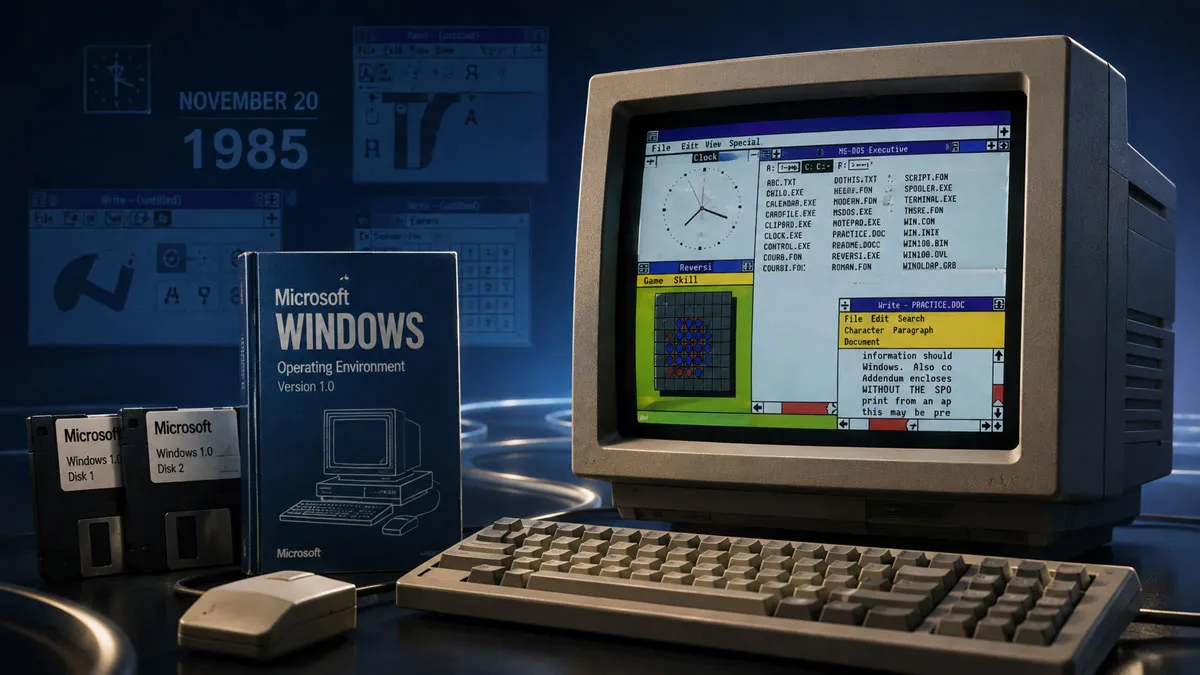
Microsoft entered the graphical personal-computer era in the mid-1980s with a software environment designed to make MS-DOS easier to use. The first retail release arrived in November 1985, marking the beginning of the Windows product line that would later become one of the most widely used desktop operating-system platforms.
Windows 1.0 Was Released In 1985
The first publicly released version was Microsoft Windows 1.0. Microsoft shipped its retail version on November 20, 1985. It was not a completely independent operating system in the modern sense. Instead, it provided a graphical environment that extended the capabilities of MS-DOS.
The distinction is important because early Windows depended on MS-DOS. Users could interact with supported software through graphical elements such as menus, windows, icons, and a mouse rather than relying exclusively on typed DOS commands.
| Milestone | Date | Significance |
|---|---|---|
| Windows announced | November 10, 1983 | Microsoft publicly introduced its planned graphical environment. |
| Windows 1.0 released | November 20, 1985 | The first retail version of Windows became available. |
| Windows 2.0 | 1987 | The next major generation expanded the Windows environment. |
| Windows 3.0 | 1990 | The platform reached a substantially broader level of adoption. |
Why Windows Was Created
Personal computers of the period commonly relied on command-line interfaces. Operating a computer therefore required users to remember and type commands. Microsoft sought to provide a more visual way of interacting with programs while retaining compatibility with the MS-DOS environment.
Windows 1.0 introduced a graphical interface with features such as pull-down menus, mouse support, tiled windows, and the ability to work with more than one application. Its design also aimed to make common computer tasks more approachable for people who were not comfortable working directly with DOS commands.
Windows 1.0 And MS-DOS
Windows 1.0 should therefore be understood as a graphical extension of MS-DOS, rather than as a modern standalone operating system. MS-DOS remained fundamental to the underlying computing environment, while Windows supplied the graphical layer through which compatible applications could be used.
This relationship also explains why early Windows releases looked and behaved very differently from later versions such as Windows 95, Windows XP, or modern Windows editions.
What Windows 1.0 Included
The first release combined the graphical environment with a collection of basic applications and utilities. Among the software associated with the original Windows environment were Paint, Write, Notepad, Calculator, a calendar, a clock, and other simple tools.
- Graphical menus and controls
- Mouse-based interaction
- Tiled application windows
- Basic multitasking of supported applications
- Built-in productivity and utility programs
One notable characteristic was that Windows 1.0 used tiled rather than freely overlapping windows. This made the interface quite different from the desktop experience that became familiar in later Windows generations.
The Difference Between The 1983 Announcement And The 1985 Release
The history of Windows sometimes creates confusion because Microsoft announced Windows before it actually became available to customers. Bill Gates introduced the planned Windows environment publicly on November 10, 1983.
The commercial product did not arrive at that time. After development and delays, Microsoft shipped the retail version on November 20, 1985. Consequently, 1983 was the year of the announcement, while 1985 was the year of the first release.
How The First Release Fits Into Windows History
Windows 1.0 was only the beginning of a long sequence of releases. Windows 2.0 followed in 1987, while Windows 3.0 arrived in 1990. Later generations progressively expanded the graphical interface, application support, hardware capabilities, and overall role of Windows on personal computers.
The early release was therefore significant not because it immediately resembled today’s Windows desktop, but because it established Microsoft’s Windows environment as a continuing graphical platform for MS-DOS-based personal computers.
Why The 1985 Release Matters
The November 1985 release represents the starting point of the Windows lineage. Its interface was limited by the hardware and software environment of the time, and it did not have all of the characteristics associated with modern operating systems. Nevertheless, it introduced a graphical approach that Microsoft continued developing through subsequent versions.
In short, the first retail Windows release was Microsoft Windows 1.0, released on November 20, 1985. Microsoft had announced the project two years earlier, in 1983, but the product itself did not reach the retail market until 1985.