
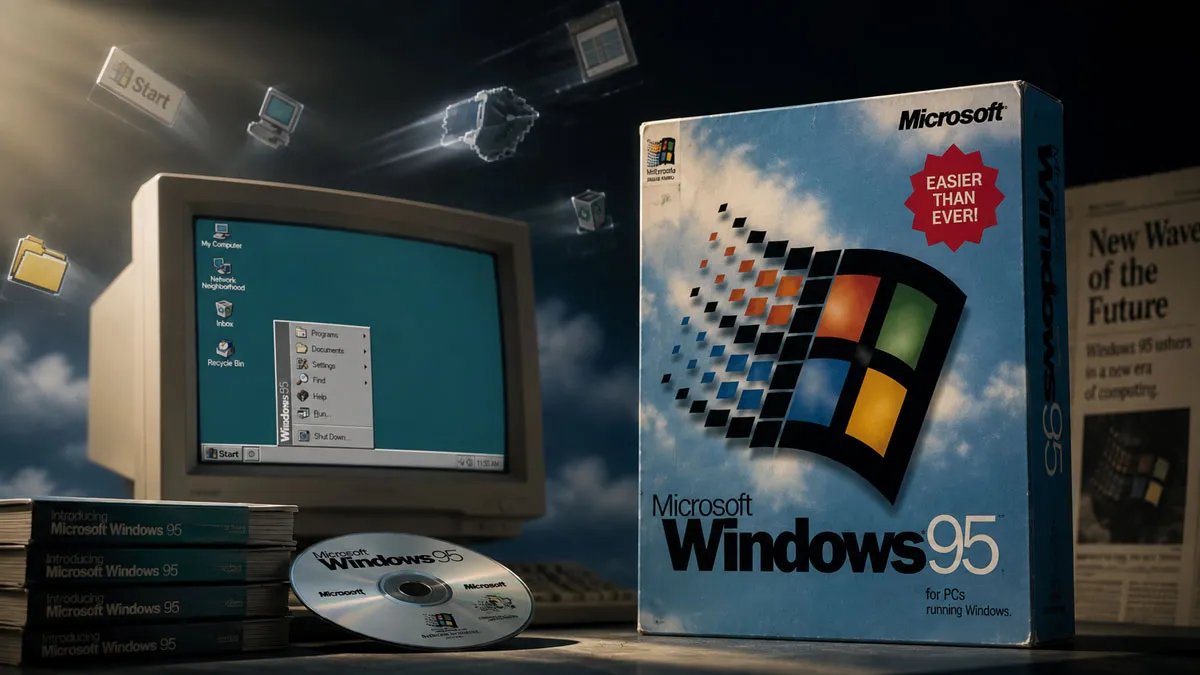
Few software releases have left such a visible mark on everyday computing as Microsoft’s Windows 95. It arrived when personal computers were moving from specialist tools toward mainstream household technology, and it combined a familiar graphical environment with a set of ideas that would shape how people used PCs for years. Its importance was not simply that it was newer than Windows 3.1; it made the computer feel more approachable, connected, and consistent with the way users expected modern software to work.
Its lasting reputation came from several factors working together: a redesigned interface, stronger support for newer hardware, improved 32-bit capabilities, easier multitasking, multimedia features, and a highly visible connection to the rapidly expanding Internet. Just as importantly, Windows 95 introduced interface conventions that became so familiar that many users eventually stopped thinking of them as innovations.
A Major Change In Everyday PC Use
Earlier versions of Windows had already established the graphical desktop, but Windows 95 reorganized that experience around a much clearer model. The desktop, taskbar, Start menu, window controls, and familiar folder structure gave users a straightforward way to launch programs, switch between open applications, find files, and access system functions.
The significance of these changes becomes clearer when looking at what they became afterward. Microsoft’s own documentation continues to describe the taskbar as a central part of Windows, combining application switching with access to the Start menu and notification functions. The basic interaction model introduced in the Windows 95 era therefore became a foundation rather than a short-lived design experiment.
| Windows 95 Element | Why It Mattered |
|---|---|
| Start menu | Provided a central place to reach programs, documents, settings, and system commands. |
| Taskbar | Made switching between running applications much more direct. |
| 32-bit support | Moved mainstream Windows further toward the capabilities of contemporary PC hardware. |
| Plug and Play | Aimed to reduce the amount of manual hardware configuration required from users. |
| Integrated networking | Reflected the growing importance of online communication and Internet access. |
The Start Menu And Taskbar Changed The Desktop
One of the most influential aspects of Windows 95 was its approach to navigation. Instead of requiring users to rely primarily on Program Manager groups and other older organizational methods, the new interface placed applications and system functions behind a single Start button.
The taskbar complemented this arrangement by giving each active application a visible place on the desktop. This made it easier to understand what was running and to move from one program to another. The result was a more coherent relationship between launching applications and managing them.
Another important detail was the introduction of recognizable window controls for minimizing, maximizing, restoring, and closing windows as part of the redesigned interface. These conventions helped establish a visual language that became deeply associated with Windows computing.
Windows 95 Arrived At An Important Hardware Moment
The operating system was also significant because it arrived during a period when PC hardware was becoming increasingly capable and varied. Windows 95 was designed to take greater advantage of 32-bit processors and provided a more modern foundation than the older Windows environment.
Its relationship with hardware was especially important. The Plug and Play concept sought to make adding supported hardware less dependent on manual configuration. Earlier PC users could encounter complicated settings involving interrupts, memory addresses, drivers, and other technical details. Windows 95 did not make hardware installation universally effortless, but it helped move the industry toward the expectation that an operating system should handle more of that complexity.
This was part of a broader shift: the computer was increasingly expected to adapt to the user rather than requiring the user to understand the computer’s internal configuration.
It Helped Bring The Internet Into The Mainstream PC Experience
Windows 95 appeared at almost exactly the moment when the World Wide Web was becoming a mainstream subject. Microsoft initially promoted its own online service alongside Windows, but the rapid growth of the Web changed the company’s direction. The Computer History Museum records this broader transition in the mid-1990s, when traditional online services faced increasing competition from the open Web.
That timing mattered. Windows 95 became associated with a PC that was no longer simply a machine for writing documents, running spreadsheets, and playing local games. Networking and communication were becoming increasingly important parts of personal computing.
Microsoft’s history of 1995 also records the arrival of Internet Explorer 1.0 for Windows 95, illustrating how closely the operating system’s era was tied to Microsoft’s rapidly developing Internet strategy. The Web itself was not created by Windows 95, and the operating system was certainly not responsible for the Internet’s growth, but its release coincided with a major transformation in what ordinary PC users expected their computers to do.
Games And Multimedia Made The PC More Personal
Another reason for Windows 95’s cultural impact was the expanding role of the home computer as an entertainment device. Better graphics, sound, CD-ROM software, and increasingly capable processors were changing the kinds of experiences a PC could provide.
Windows 95 supported this transition by providing a more consumer-oriented platform for software developers. Games and multimedia applications increasingly became part of the ordinary Windows ecosystem rather than something separate from everyday productivity.
The importance of this development was broader than any individual game. As computers became associated with entertainment as well as work, they became more deeply integrated into home life. Windows 95 arrived at a point when those two uses were beginning to converge.
The Launch Became A Cultural Event
Technology products rarely become memorable solely because of their technical specifications. Windows 95 benefited from an unusually prominent launch that treated an operating system as a mainstream consumer product.
Microsoft’s contemporary accounts describe major public attention around the release, including large crowds and extensive promotional activity. The campaign connected the product with popular culture, most famously through the use of the Rolling Stones song Start Me Up. The marketing helped turn an operating-system release into something recognizable even to people who were not deeply interested in computing.
That visibility reinforced an important change in perception: the personal computer was becoming a mainstream consumer product, and its operating system could itself become part of popular culture.
It Was Not Perfect
Its legendary status should not be confused with technical perfection. Windows 95 still carried substantial compatibility and architectural baggage from earlier Windows generations. Its hybrid design combined newer 32-bit components with significant legacy elements, reflecting the practical need to support existing software and hardware.
Hardware configuration could still be troublesome, drivers could cause problems, and compatibility was not guaranteed. Some applications and devices worked differently depending on their particular drivers or configurations. The operating system therefore represented a transition rather than a complete break with the past.
That transitional character is actually part of its historical importance. Microsoft was attempting to move a huge existing software ecosystem toward a newer computing model without simply abandoning everything that had come before.
Why Its Influence Lasted
The strongest evidence of Windows 95’s long-term importance is not nostalgia but continuity. Many of the interaction patterns it popularized survived through later versions of Windows, even as the underlying technology changed dramatically.
- The Start menu became a familiar central point for accessing software and system functions.
- The taskbar established a durable method for managing open applications.
- Plug and Play helped advance the expectation of easier hardware installation.
- The desktop-and-folder model remained central to mainstream PC navigation.
- Windows increasingly became a platform for both productivity and entertainment.
Microsoft later carried the Windows 95 user interface into the Windows NT line, contributing to the convergence of the consumer and professional Windows experiences. This helped preserve the basic interaction model even as the underlying operating-system architecture evolved.
The Legacy Of Windows 95
Windows 95 was important because several technological and cultural changes happened at the same time. PCs were becoming more powerful, hardware was becoming more diverse, the Web was expanding rapidly, multimedia was becoming mainstream, and computers were moving deeper into ordinary homes.
The operating system gave these developments a recognizable interface and a widely distributed platform. Its Start menu and taskbar were particularly influential because they translated complicated computing tasks into interactions that could be learned quickly and remembered easily.
That combination explains why Windows 95 occupies such a distinctive place in computing history. It was neither the first graphical operating system nor the beginning of personal computing. Its significance came from bringing several emerging trends together in a product that reached a mass audience and established interface conventions that endured long after the original software disappeared.