
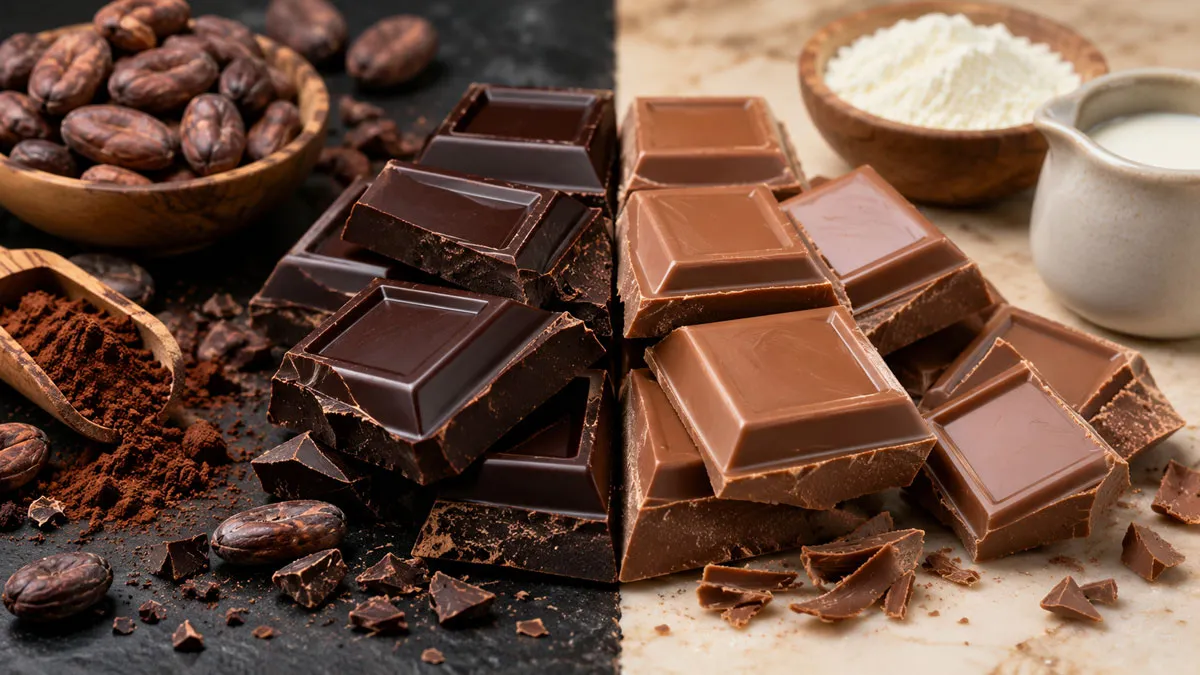
Dark and milk chocolate are made from the same basic ingredient—cocoa—but they differ substantially in their proportions of cocoa components, milk ingredients, sugar, flavor, texture, and typical nutritional profile. These differences affect not only how each type tastes but also how it behaves in cooking and how much cocoa-derived compounds it can provide.
The most important distinction is simple: dark chocolate generally contains a higher proportion of cocoa ingredients and no milk as a defining ingredient, while milk chocolate combines cocoa with milk ingredients and is usually sweeter. However, the category is broader than this basic definition suggests, because individual products can vary considerably in formulation.
How Dark And Milk Chocolate Are Made Differently
Chocolate begins with cacao beans. After fermentation and drying, the beans are roasted and processed into cocoa components such as cocoa solids and cocoa butter. Manufacturers then combine these components with ingredients such as sugar, and milk chocolate also includes milk ingredients.
Dark chocolate is formulated to emphasize the flavor of cocoa. Depending on the product, it can contain cocoa mass, cocoa butter, sugar, and other ingredients such as vanilla or emulsifiers. Milk chocolate adds milk powder or another permitted milk ingredient, producing a lighter color, creamier texture, and softer flavor.
There is no single composition that applies to every bar described informally as “dark chocolate.” The amount of cocoa can vary significantly, which is why the percentage printed on a dark chocolate package is useful when comparing products.
| Characteristic | Dark Chocolate | Milk Chocolate |
|---|---|---|
| Cocoa presence | Typically higher | Typically lower than dark chocolate |
| Milk ingredients | Not a defining ingredient | Characteristic ingredient |
| Typical sweetness | Lower to moderate, depending on formulation | Usually higher |
| Flavor | More intense, bitter, or roasted | Creamier and sweeter |
| Color | Usually deeper brown | Usually lighter brown |
| Texture | Firm, with a pronounced cocoa character | Generally creamier and smoother |
Cocoa Is The Main Difference
When comparing dark chocolate products, the cocoa percentage is an important clue to their composition. A higher percentage generally means that a larger share of the product comes from cocoa ingredients rather than sugar and other additions.
This does not mean that a higher percentage automatically makes a chocolate better or universally healthier. Cocoa percentage describes composition, not overall nutritional quality. A chocolate bar can contain a high proportion of cocoa while still being energy-dense because cocoa butter and other fats contribute substantial calories.
Milk chocolate usually contains a greater proportion of sugar and milk ingredients relative to cocoa than many dark chocolate products. The result is a flavor profile in which sweetness and creaminess can mask some of the naturally bitter and acidic characteristics of cocoa.
Why The Flavor And Texture Are So Different
Dark Chocolate Has A Stronger Cocoa Character
The bitterness of dark chocolate is partly associated with cocoa components and the compounds produced during cacao processing. With less milk and, in many products, less sugar to soften those flavors, cocoa tends to dominate the sensory experience.
Dark chocolate can therefore range from relatively mild and sweet to intensely bitter. A bar with a lower cocoa percentage may taste quite approachable, while a very high-cocoa chocolate can have pronounced bitter, roasted, fruity, earthy, or acidic notes.
Milk Chocolate Emphasizes Sweetness And Creaminess
Milk ingredients contribute proteins, lactose, and other components that influence both flavor and texture. Combined with sugar and cocoa butter, they produce the characteristic smooth and creamy quality associated with milk chocolate.
For this reason, milk chocolate is often perceived as less bitter than dark chocolate even when both products originate from the same cacao beans.
Dark Chocolate And Milk Chocolate Nutritional Differences
It is tempting to describe dark chocolate as simply the “healthy” version of chocolate and milk chocolate as the “unhealthy” version. That interpretation is too simplistic.
Both varieties are concentrated foods containing substantial amounts of energy, and their nutritional values depend on the particular formulation. Sugar, cocoa butter, milk ingredients, serving size, and other additions all influence the final product.
Dark chocolate can provide more cocoa-derived compounds per comparable amount when it contains substantially more cocoa than a milk chocolate product. Cocoa naturally contains flavanols and other polyphenolic compounds that have been investigated for their biological effects. However, processing can alter flavanol , and the amount present varies among cocoa products.
Research on cocoa and chocolate does not justify treating ordinary chocolate as a medicine. Human studies have investigated possible effects on cardiovascular and metabolic measures, but findings vary according to the product, amount consumed, study population, and duration. A systematic review of randomized trials in healthy people found limited and generally low-to-moderate-quality evidence for many commonly claimed health effects.
The practical distinction is therefore not that dark chocolate is automatically healthy and milk chocolate is automatically unhealthy. Rather, a chocolate’s cocoa , sugar , portion size, and overall place in the diet matter more than the name of the category alone.
Does Dark Chocolate Always Contain Less Sugar?
Not necessarily. Dark chocolate often contains less sugar than milk chocolate, particularly when comparing products with relatively high cocoa percentages. However, cocoa percentage and sugar are separate characteristics.
A relatively mild dark chocolate can contain considerable sugar, while a high-cocoa product generally has less room for sugar because more of the formulation is occupied by cocoa ingredients. The nutrition label is therefore more reliable than the color or the word “dark” when determining how much sugar a particular product contains.
Which Type Contains More Cocoa Flavanols?
Cocoa flavanols are naturally occurring plant compounds found in cacao. Because dark chocolate commonly contains more cocoa material than milk chocolate, it can provide more cocoa-derived flavanols per serving. However, this should not be assumed solely from the chocolate’s color or percentage.
Processing methods can substantially affect flavanol concentrations, and different cocoa sources can have different compositions. Consequently, two dark chocolates with similar cocoa percentages may not contain identical amounts of these compounds.
Milk ingredients can also complicate comparisons. Some research has examined whether milk affects the absorption or biological activity of cocoa polyphenols, but the evidence does not support a simple rule that milk chocolate eliminates the potential effects of cocoa compounds.
Choosing Between Dark And Milk Chocolate
The appropriate choice depends largely on what the person wants from the chocolate. Dark chocolate may be preferable for someone seeking a stronger cocoa flavor and a product with a higher proportion of cocoa ingredients. Milk chocolate may be more appealing to someone who prefers sweetness and a creamy texture.
For everyday dietary choices, several details are more informative than the category name:
- Cocoa percentage: useful for understanding the relative proportion of cocoa ingredients, particularly in dark chocolate.
- Added sugar: important when comparing sweetness and total sugar intake.
- Serving size: chocolate is energy-dense, so the quantity consumed matters.
- Ingredient list: helpful for identifying milk, nuts, emulsifiers, flavorings, and other additions.
How The Two Types Behave In Cooking
The differences between dark and milk chocolate also matter in the kitchen. Dark chocolate’s stronger cocoa flavor can provide greater contrast in desserts and is often useful when a recipe needs a pronounced chocolate character without excessive sweetness.
Milk chocolate contributes sweetness, dairy richness, and a softer chocolate flavor. It can work particularly well in confectionery, fillings, sauces, and desserts where a creamy profile is desirable.
They should not always be substituted in equal amounts without considering the recipe. Replacing milk chocolate with a much darker chocolate can reduce sweetness and intensify bitterness, while replacing dark chocolate with milk chocolate can increase sweetness and alter the balance of a dessert.
The Bottom Line
Dark and milk chocolate share the same cacao origins but are designed around different ingredient balances. Dark chocolate generally emphasizes cocoa, while milk chocolate combines cocoa with milk ingredients and a sweeter, creamier profile.
Dark chocolate can contain more cocoa-derived flavanols, but its nutritional advantages should not be exaggerated. Chocolate remains a concentrated food, and the actual composition varies substantially between products. Looking at the cocoa percentage, sugar , ingredient list, and serving size provides a more meaningful comparison than assuming that one category is inherently good and the other inherently bad.
Ultimately, the difference is best understood as one of composition, taste, texture, and degree of cocoa concentration rather than a simple division between healthy and unhealthy chocolate.