
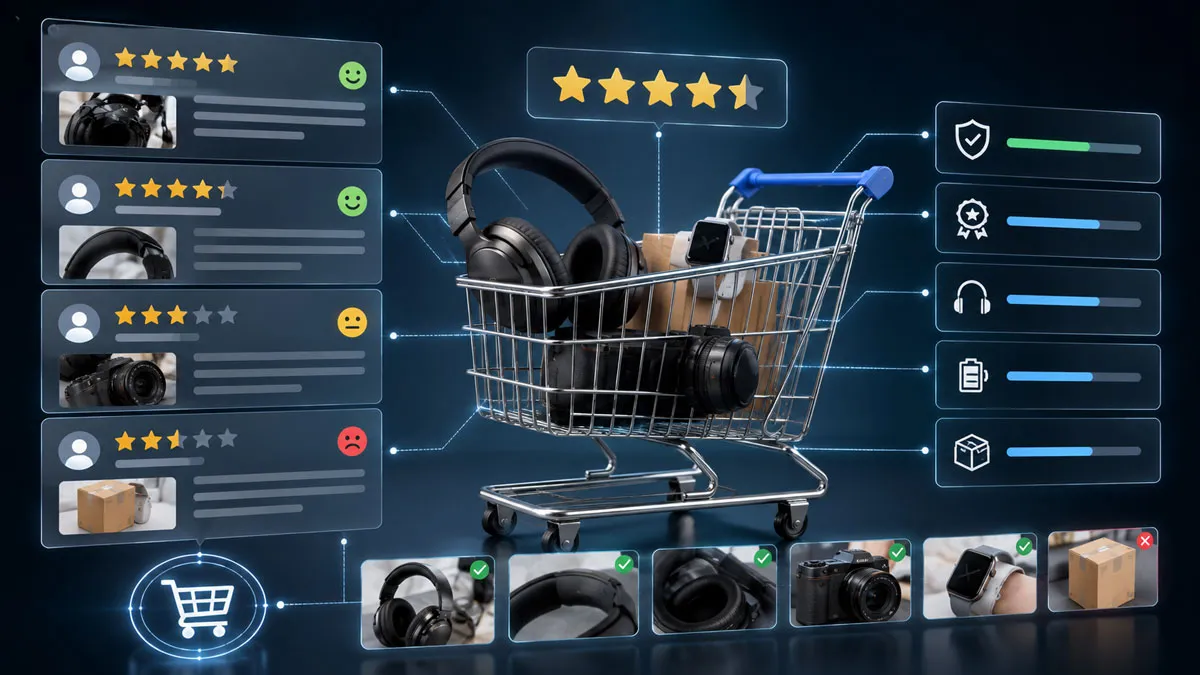
Online shopping reviews can be extremely useful before making a purchase. They provide something that product descriptions often cannot: the experience of people who have actually used the item. Reviews may reveal whether a pair of shoes runs small, whether a kitchen appliance is difficult to clean, whether a laptop battery performs as expected, or whether a product looks different from its photographs.
However, reviews are not automatically reliable simply because they appear beside a product. Some may be incomplete, outdated, exaggerated, incentivized, or fabricated. Consumer-protection authorities in several European countries have warned that online reviews can be manipulated, including through fake positive reviews, selective removal of negative feedback, and undisclosed incentives.
The most useful approach is therefore neither to trust reviews blindly nor to ignore them. Reviews work best as one source of evidence among several. When read critically and combined with product specifications, return policies, seller information, and independent testing, they can make an online purchasing decision considerably more informed.
Why Online Reviews Can Be Useful
A product page normally presents information supplied or controlled by the seller. Reviews can add a different perspective by describing what happens after the product leaves the warehouse and reaches an actual customer.
This is particularly valuable for characteristics that are difficult to judge from specifications alone. A manufacturer may state the dimensions of a chair, for example, but a reviewer might explain whether it feels comfortable after several hours of use. A clothing retailer can provide measurements, while customers may reveal whether the material stretches, feels heavy, or looks different in ordinary lighting.
Reviews can also identify recurring problems. One isolated complaint does not necessarily indicate a defective product. However, if numerous independent reviewers describe the same issue, the pattern deserves attention.
| What Reviews Can Reveal | What They Usually Cannot Prove |
|---|---|
| Everyday usability and practical experiences | That every customer will have the same experience |
| Recurring complaints or common strengths | Technical performance under controlled conditions |
| Possible differences between product photographs and reality | Long-term reliability based on very recent reviews |
| Packaging, delivery, fit, comfort, and ease of use | That a highly rated product is objectively the best choice |
Why A High Star Rating Is Not Enough
A five-star average looks reassuring, but the number alone contains very little context. A product with thousands of reviews may appear safer than one with only a few dozen, yet the quality and authenticity of those reviews still matter.
Consumer organizations have documented cases in which online ratings were affected by manipulated or interested reviews. The German consumer organization Verbraucherzentrale, for example, advises shoppers not to rely blindly on ratings because reviews can be manipulated or completely fabricated. It also points to warning signs such as large numbers of positive reviews appearing within a short period, repetitive wording, unusually generic praise, and reviewers who consistently give five-star ratings.
The French consumer authority DGCCRF similarly advises consumers to diversify their sources of information. Its guidance notes that fake positive reviews can be created by businesses, third parties, or individuals receiving compensation, while negative reviews can also be manipulated or suppressed.
This creates an important distinction: a review can be genuine without being universally representative. A customer may honestly love a product because it suits their particular needs, while another customer may dislike the same product for equally legitimate reasons.
How To Read Reviews More Effectively
Look Beyond The Average Rating
Start with the overall rating, but do not stop there. Read a selection of positive, neutral, and negative reviews. The middle ratings can be especially informative because they often describe both advantages and disadvantages rather than presenting the product as perfect or terrible.
Pay attention to repeated observations. If several unrelated customers mention the same sizing problem, battery limitation, manufacturing defect, or compatibility issue, that information may be more useful than dozens of short comments saying only that the product is “great.”
Read The Details, Not Just The Stars
A useful review explains what happened. Specific information is generally more valuable than emotional language.
- Look for descriptions of how the product was actually used.
- Compare comments about the same feature across multiple reviews.
- Check the dates to see whether the information is still relevant.
- Pay attention to reviews that identify both strengths and weaknesses.
- Consider whether the reviewer has a need or usage pattern similar to yours.
A review stating that a backpack became uncomfortable after carrying it for several hours provides more useful information than a simple five-star rating. Likewise, a complaint about a phone’s battery should be interpreted differently if the reviewer uses demanding applications all day rather than using the device lightly.
Check Whether Reviews Are Verified Or Explained
Some platforms indicate whether a reviewer purchased or used a product. Such labels can provide useful context, but they should not be treated as an absolute guarantee that every statement is accurate.
More important is whether the platform clearly explains how reviews are collected, checked, moderated, and displayed. European consumer rules place importance on informing shoppers about whether and how businesses verify that reviews originate from people who actually used or purchased the relevant product.
Transparency matters because a review system can create a misleading impression even without inventing individual comments. For example, selectively highlighting positive feedback or giving unexplained prominence to certain reviews can influence how shoppers perceive the overall rating.
Warning Signs Of Unreliable Reviews
No single characteristic proves that a review is fake. Nevertheless, several warning signs can justify closer examination.
- Large numbers of highly positive reviews appear within an unusually short period.
- Many reviews use very similar wording or identical phrases.
- Comments contain enthusiastic praise but almost no concrete information about using the product.
- A reviewer appears to give exceptionally positive ratings to almost everything.
- The reviews contain claims that sound more like advertising than personal experience.
- There is a striking difference between the written reviews and the overall rating.
- Negative reviews repeatedly mention the same problem while the positive reviews never address it.
These signals should be treated as reasons to investigate rather than automatic proof of manipulation. A popular product can naturally receive many reviews after a promotion, and different customers may independently use similar language.
Why Negative Reviews Can Be Valuable
Negative reviews are often more useful when they describe a specific problem and explain its circumstances. A one-star comment saying only “terrible product” provides little information. A detailed complaint explaining that the item broke after three weeks of ordinary use is much more informative.
At the same time, negative feedback should not automatically outweigh positive feedback. Some complaints concern expectations rather than actual defects. A customer might criticize a small product for being smaller than expected even though its published dimensions were accurate.
The key question is not simply, “Are there negative reviews?” It is, “What do the negative reviews actually demonstrate?”
Look for patterns, severity, frequency, and relevance to your own needs. A minor inconvenience may not matter to one buyer but may be decisive for another.
Reviews Should Be Combined With Other Evidence
Reviews are strongest when they answer questions that specifications cannot. They should not replace basic research about the product or seller.
Before buying an unfamiliar or expensive product, consider checking:
- The manufacturer’s specifications and compatibility information.
- The seller’s identity, reputation, and contact details.
- The warranty, return, refund, and replacement conditions.
- Independent product comparisons or technical testing where available.
- The age of the product model and whether a newer version has replaced it.
This approach is particularly important for electronics, appliances, tools, children’s products, and other purchases where technical performance or safety can matter more than subjective impressions.
Independent testing can also compensate for one of the main limitations of customer reviews: most reviewers test products under their own personal circumstances rather than under standardized conditions. A customer can describe their experience accurately while still being unable to establish whether a product performs consistently across different situations.
When Reviews Are Most Helpful
Reviews tend to be especially useful when the product involves subjective or practical characteristics. Clothing fit, comfort, noise, ease of assembly, packaging quality, user interface, and everyday convenience are examples where first-hand experiences can add substantial value.
They can also be helpful when comparing otherwise similar products. If two products have similar specifications and prices, reviews may reveal differences in usability or recurring customer frustrations that are not obvious from the product pages.
However, the more consequential the purchase, the less sensible it is to rely on reviews alone. For expensive products, specialized equipment, or purchases with significant long-term consequences, independent evidence deserves greater attention.
A Practical Review-Checking Method
A simple process can make review research more efficient without requiring you to read hundreds of comments.
- Check the overall rating and the number of reviews.
- Read several detailed positive and negative reviews.
- Look for recurring themes rather than isolated complaints.
- Check review dates and consider whether the product has changed.
- Look for information about verification, incentives, and review moderation.
- Compare customer experiences with the official specifications.
- Check at least one independent source when the purchase is important or expensive.
This method changes the purpose of reviews. Instead of asking, “Do people like this product?”, you are asking more useful questions: “What problems occur repeatedly?”, “Does this product suit my particular needs?”, and “Is the overall impression consistent with other evidence?”
The Difference Between Useful Reviews And Decision-Making
Online reviews can reduce uncertainty, but they cannot eliminate it. Even an authentic review describes one person’s experience at one point in time. Products can also change through manufacturing revisions, software updates, different sellers, or changes in included accessories.
There is another important limitation: people tend to notice different things. One shopper may care most about appearance, while another cares about durability. One person may consider a product easy to use, while another finds its controls confusing.
For this reason, the most reliable interpretation is usually not the review with the strongest opinion. It is the information that remains consistent across multiple independent experiences and agrees with objective product information.
So, Do Online Shopping Reviews Help Before You Buy?
Yes, online shopping reviews can help substantially before a purchase, but their value depends on how critically they are evaluated. They are particularly good at revealing everyday experiences, recurring inconveniences, practical advantages, and problems that may not appear in a formal product description.
They become less reliable when shoppers treat star ratings as definitive evidence, assume every reviewer is independent, or ignore signs that reviews may have been manipulated. Consumer organizations in France, Germany, and Spain have all highlighted the importance of caution, transparency, and using more than one source of information.
The most sensible role for reviews is therefore as evidence, not a verdict. Read across different ratings, look for detailed and consistent experiences, consider the date and context, investigate unusual patterns, and compare what customers say with specifications and independent information. Used this way, reviews can turn an online product page from a marketing presentation into a more balanced picture of what buying the product may actually be like.