
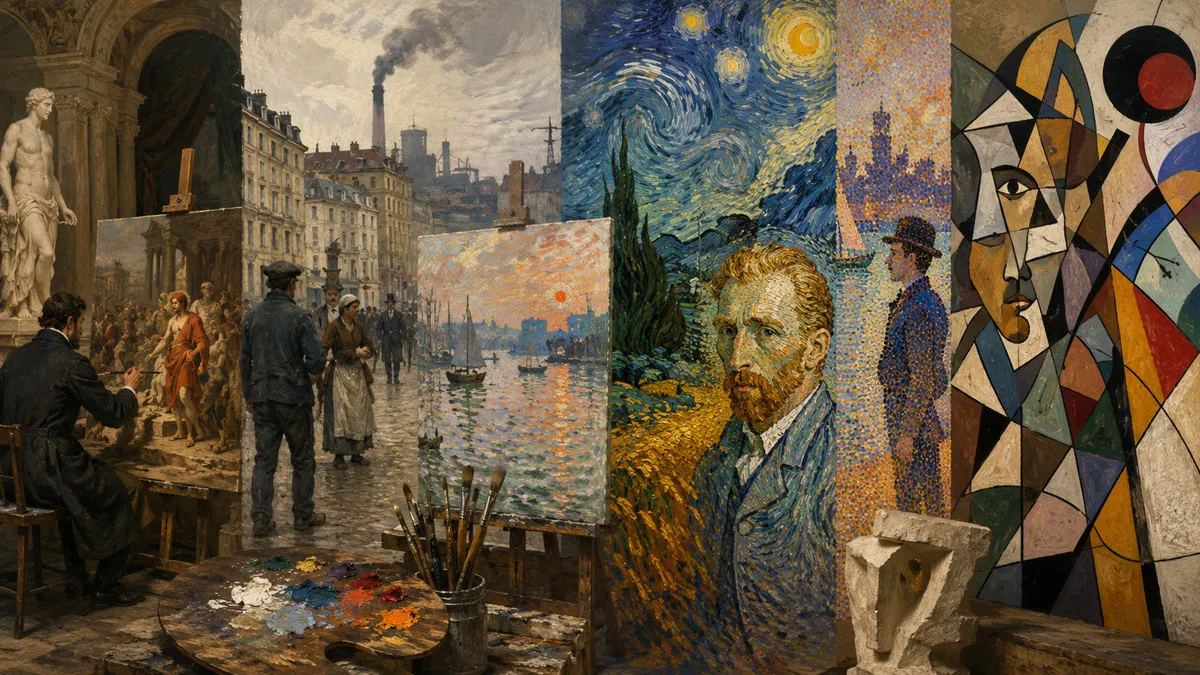
Modern art emerged gradually during the nineteenth century as artists began questioning established ideas about what art should depict, how it should look, and who should decide what was worthy of exhibition. Rather than appearing at a single moment, it developed through a series of changes in subject matter, technique, artistic independence, and ideas about representation.
The transition was especially visible in France, where Realism, Impressionism, and later Post-Impressionism challenged academic traditions. By the early twentieth century, artists were no longer simply trying to reproduce the visible world. They were increasingly exploring perception, structure, color, emotion, imagination, and the nature of the artwork itself.
The Academic Tradition Before Modern Art
For much of the nineteenth century, European art institutions placed considerable importance on academic standards. Historical, religious, and mythological subjects were generally regarded as particularly prestigious, while artists were expected to demonstrate technical control through established methods of composition, drawing, perspective, and finish.
The official exhibition system also influenced artistic careers. In Paris, the Salon played a major role in determining which artists could gain public attention. This did not mean that all artists followed the same style, but it created a powerful institutional framework against which younger painters increasingly reacted.
The transformation therefore involved more than a change in appearance. Artists increasingly challenged the assumption that artistic quality depended on following inherited rules. The question gradually shifted from “How accurately can reality be represented?” toward broader questions about how reality is experienced and how an artist can interpret it.
Realism Helped Change The Subject Of Art
One important step toward modern art was the rise of Realism in the mid-nineteenth century. Artists such as Gustave Courbet rejected the idea that painting needed to concentrate mainly on idealized historical or mythological subjects.
Ordinary people, contemporary life, labor, and everyday environments could become serious artistic subjects. This expanded the range of experiences that painters considered worthy of representation and weakened the distinction between supposedly elevated subjects and ordinary life.
The change was significant because it connected artistic innovation with contemporary experience. Modern art would later take this principle much further, repeatedly turning toward the world in which artists actually lived.
Impressionism Broke With Established Painting Conventions
During the 1860s and 1870s, a group of painters including Claude Monet, Pierre-Auguste Renoir, Edgar Degas, Berthe Morisot, Camille Pissarro, and Alfred Sisley developed approaches that became associated with Impressionism.
Impressionist artists were interested in fleeting visual experiences, changing light, movement, and scenes from contemporary life. Their paintings often used visible brushwork and lighter, more varied color relationships rather than the highly finished surfaces associated with academic painting.
The movement was also important institutionally. Beginning in 1874, Impressionist artists organized independent exhibitions rather than depending entirely on the official Salon. They eventually held eight group exhibitions between 1874 and 1886.
| Period | Important Development | Contribution To Modern Art |
|---|---|---|
| Mid-19th century | Realism | Expanded acceptable subjects to contemporary and ordinary life |
| 1860s–1880s | Impressionism | Changed approaches to light, color, brushwork, and modern experience |
| 1880s–1900s | Post-Impressionist developments | Pushed painting toward stronger structure, symbolism, expressive color, and abstraction |
| Early 20th century | Avant-garde movements | Radically reconsidered representation, space, form, and the definition of art |
Post-Impressionism Opened Several New Directions
Impressionism did not lead to one single successor. Instead, artists associated with the period after Impressionism pursued very different solutions to the problems of painting.
Paul Cézanne investigated the underlying structure of forms and space. Vincent van Gogh used intensified color and energetic brushwork to create a highly personal visual language. Georges Seurat explored systematic approaches to color and perception, while Paul Gauguin pursued simplified forms, strong colors, and symbolic possibilities.
For this reason, Post-Impressionism is better understood as a broad historical grouping than as one unified style. Its importance lies partly in the fact that artists began moving beyond the immediate visual impression toward individual artistic systems and interpretations.
- Cézanne emphasized structure and the organization of pictorial space.
- Van Gogh developed an intensely expressive approach to color and brushwork.
- Seurat investigated systematic relationships between color and visual perception.
- Gauguin explored simplified forms, strong color, and symbolic expression.
Artists Began Questioning Perspective And Representation
Traditional European painting had developed sophisticated systems for creating the appearance of three-dimensional space on a flat surface. During the late nineteenth and early twentieth centuries, however, artists increasingly questioned whether painting needed to imitate ordinary visual perception at all.
Cézanne was particularly important in this transition. His investigations into form and spatial organization influenced younger artists who wanted to construct paintings rather than simply reproduce what the eye appeared to see.
This helped prepare the ground for a more radical transformation in the early twentieth century. Once artists accepted that a painting could have its own internal structure, there was less reason to preserve traditional perspective as an absolute rule.
Cubism Transformed The Meaning Of Representation
By the beginning of the twentieth century, the development of modern art accelerated. Pablo Picasso and Georges Braque became central figures in Cubism, a movement that developed in Paris from the late 1900s.
Cubist artists questioned the conventional idea that a single fixed viewpoint was necessary for representing an object. They fragmented forms, combined different viewpoints, and reorganized objects into interconnected planes.
Collage and the use of ordinary materials also expanded the possibilities of painting. Instead of treating the artwork simply as a window onto the external world, Cubism emphasized the physical and constructed nature of the image.
The consequences were far-reaching. Cubism contributed to the development of abstraction and influenced numerous later approaches to painting and sculpture. It demonstrated that modern art could fundamentally alter the visual language used to describe reality.
Modern Art Was A Gradual Change, Not A Single Invention
It is tempting to identify one artist, painting, or year as the beginning of modern art, but the historical development was considerably more complicated. Different artists challenged different parts of the established system at different times.
Several changes occurred together:
- Artists increasingly represented contemporary life rather than relying exclusively on traditional subjects.
- Independent exhibitions reduced dependence on established institutions.
- Visible brushwork and unconventional compositions challenged academic standards of finish.
- Color became increasingly independent from the literal appearance of objects.
- Artists investigated personal expression, symbolism, structure, and perception.
- Early twentieth-century movements questioned whether art needed to imitate visible reality at all.
These developments did not replace one style with another overnight. Academic art, Realism, Impressionism, Symbolism, Post-Impressionism, Fauvism, Cubism, and other approaches overlapped and interacted. Artists could adopt ideas from several movements while rejecting other aspects of them.
Why Modern Art Became Possible
The emergence of modern art can therefore be understood as a combination of artistic, institutional, and cultural changes. Artists gained greater freedom to exhibit independently, experiment with unfamiliar techniques, and pursue personal objectives rather than conforming to a single accepted model.
At the same time, the modern city and contemporary life provided new subjects and experiences. Photography also altered the relationship between painting and visual representation, making it increasingly possible for painters to investigate purposes other than simply recording appearances.
The most important change was conceptual. Artists increasingly recognized that art did not have to reproduce reality in one predetermined way. A painting could interpret, reorganize, simplify, distort, symbolize, or even abandon recognizable objects altogether.
From Modern Art To Modernism
By the early twentieth century, the developments that had begun with nineteenth-century challenges to academic conventions had expanded into a much broader modernist culture. Fauvism, Expressionism, Cubism, and early abstraction offered radically different answers to questions about color, form, emotion, space, and representation.
The transition was therefore not a straightforward march toward abstraction. Modern art developed through competing experiments. Some artists intensified realism, while others distorted recognizable forms or removed them almost entirely. What connected many of these experiments was a willingness to reconsider assumptions that earlier generations had treated as fundamental.
Modern art began, in this sense, not with a single manifesto or masterpiece but with a sustained questioning of artistic conventions. The process started visibly in nineteenth-century Realism and Impressionism, expanded through Post-Impressionist experimentation, and became increasingly radical in the early twentieth century. Its defining feature was not one particular appearance, but the growing conviction that artists could determine for themselves how art should represent, interpret, or construct the world.