
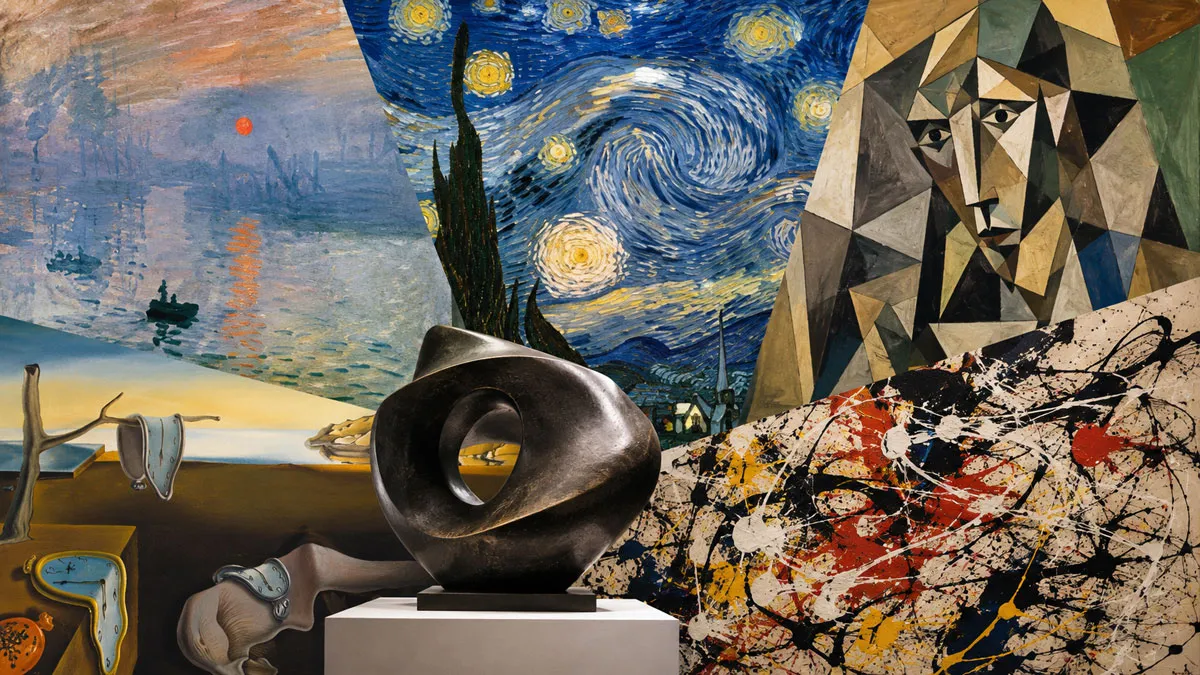
The term describes a broad period of artistic experimentation that developed as artists responded to rapid changes in society, technology, urban life, politics, and ideas about individual expression. Rather than following a single visual style, artists increasingly questioned established rules about how art should look, what subjects were appropriate, and even what could qualify as a work of art. The period is commonly associated with the late nineteenth and much of the twentieth century, although its exact boundaries vary among museums and art historians.
What connects many of these works is not one particular appearance but a willingness to challenge artistic conventions. Realistic representation could be abandoned, traditional materials could be reinterpreted, and ordinary objects, photography, film, design, and new forms of abstraction could become part of artistic practice.
When Did Modern Art Begin And End?
There is no universally accepted starting or ending date. Some accounts trace its emergence to the 1860s, when artists such as Édouard Manet challenged established conventions of painting. Other histories place the decisive beginning later in the nineteenth century, particularly with Impressionism and the growing interest in modern urban life.
Many museum collections use a broad period extending from roughly the 1880s to the 1970s. This range includes major developments such as Impressionism, Post-Impressionism, Fauvism, Cubism, Dada, Surrealism, abstraction, and Pop Art. The Centre Pompidou, for example, has also presented modern art through a wider international history rather than treating it as a simple progression of Western avant-garde movements.
The transition toward contemporary art is equally difficult to assign to one year. By the later twentieth century, many artists were increasingly questioning the assumptions of modernism itself, contributing to practices associated with contemporary and postmodern art.
| Period | Broad Characteristics | Representative Developments |
|---|---|---|
| Late 19th Century | Greater attention to modern life, perception, and individual artistic expression | Impressionism and Post-Impressionism |
| Early 20th Century | Radical experimentation with form, color, space, and subject matter | Fauvism, Cubism, Futurism, Expressionism, Dada, and Surrealism |
| Mid-20th Century | Expansion of abstraction, gesture, new materials, and mass-cultural imagery | Abstract Expressionism, Pop Art, and related practices |
| Later 20th Century | Increasing challenges to established definitions of artistic medium and authorship | Conceptual, Minimalist, performance, installation, and other experimental practices |
Why Did Modern Art Develop?
The emergence of new artistic approaches was closely connected with profound changes in everyday life. Industrialization transformed cities and manufacturing. Photography challenged painting’s traditional role as a means of recording appearances. New forms of transportation and communication altered perceptions of distance and time. Mass-produced goods, advertising, newspapers, cinema, and other technologies created unfamiliar visual environments.
Artists also encountered changing intellectual and social ideas. Traditional institutions such as academic art establishments no longer held an uncontested position, while independent galleries, exhibitions, critics, collectors, and new museums created additional ways for artists to present their work.
These developments did not produce one unified artistic response. Some artists concentrated on perception and everyday experience, while others explored emotion, geometry, dreams, political subjects, spirituality, or the possibilities of non-representational art.
What Are The Main Characteristics Of Modern Art?
Because the period encompasses many different movements, no single list describes every work. Nevertheless, several recurring characteristics help explain why this period represents such a major transformation in the history of art.
- Experimentation: Artists tested unfamiliar techniques, materials, compositions, and methods of presentation.
- Individual expression: Personal experience, emotion, imagination, and subjective perception became increasingly important.
- Departure from realism: Artists could distort, simplify, fragment, or completely abandon recognizable representation.
- Interest in modern life: Cities, industry, technology, popular entertainment, and ordinary experiences became important subjects.
- Questioning tradition: Artists challenged established ideas about beauty, technique, subject matter, and artistic authority.
- Expansion of artistic media: Photography, film, design, typography, found objects, and other forms increasingly entered artistic practice.
Major Movements Within Modern Art
Impressionism
Impressionist artists placed greater emphasis on the experience of seeing rather than highly polished historical or mythological compositions. They explored changing light, color, atmosphere, and scenes from contemporary life. Their approach helped establish a broader willingness to reconsider established painting techniques.
Post-Impressionism
Post-Impressionism was not a single unified style. Artists associated with it pursued different goals, including structural organization, expressive color, symbolism, and intensified personal expression. Vincent van Gogh, Paul Cézanne, and Paul Gauguin illustrate how artists could move beyond Impressionist approaches in very different directions.
Fauvism And Expressionism
These approaches demonstrated that color and form did not necessarily have to reproduce the visible world accurately. Fauvist artists used unusually strong colors and simplified forms, while Expressionist artists frequently distorted appearances to communicate emotional or psychological intensity.
Cubism
Cubism radically reconsidered pictorial space. Associated especially with Pablo Picasso and Georges Braque, it fragmented and reorganized recognizable subjects rather than presenting them from one conventional viewpoint. This encouraged artists to think about a picture as an constructed arrangement of shapes, planes, and relationships.
Dada And Surrealism
Dada emerged during the First World War as artists questioned conventional ideas of logic, culture, and artistic value. Its experiments included unusual combinations of materials, performance, collage, and found objects. Surrealism subsequently explored dreams, the unconscious, unexpected associations, and irrational imagery.
Abstraction
Abstract artists reduced or eliminated recognizable subject matter to investigate elements such as line, shape, color, rhythm, and composition. Abstraction could take many forms, from geometric systems to highly gestural painting. It was not simply an attempt to make images less realistic; it reflected a broader question about what a visual artwork could communicate without depicting a recognizable scene.
Pop Art
Pop Art brought imagery associated with advertising, consumer products, celebrities, comics, and mass media into fine-art contexts. Artists such as Andy Warhol and Roy Lichtenstein examined the relationship between art, popular culture, reproduction, and consumer society.
How Did Modern Artists Change The Idea Of Art?
One of the most significant changes was the growing belief that an artwork did not have to demonstrate traditional craftsmanship or depict a conventional subject. Marcel Duchamp’s readymades provide a particularly influential example. By presenting an ordinary manufactured object as art, Duchamp shifted attention toward choice, context, authorship, and the definition of an artwork.
This development did not mean that technique became irrelevant. Instead, the role of artistic decision-making expanded. An artist might communicate through the selection of an object, the arrangement of materials, the structure of an installation, or the concept behind a work rather than relying exclusively on painting or sculpture.
Modern art therefore changed not only the appearance of artworks but also the questions viewers were expected to ask. Instead of considering only whether an image accurately represented something, viewers could consider why particular materials were selected, how a work was constructed, what assumptions it challenged, and how its context affected its meaning.
Is Modern Art The Same As Contemporary Art?
No. The terms describe different periods, although their boundaries are not completely fixed.
Modern art generally refers to the historical period associated with the major artistic transformations of the late nineteenth and twentieth centuries. Contemporary art generally refers to art of the present and recent past. The distinction is therefore primarily historical rather than a statement about whether something looks modern or old-fashioned.
This distinction matters because the word “modern” can have two meanings in ordinary language. Something can be modern in the sense of being recent, while “modern art” in art history usually identifies a particular historical tradition and period.
Why Modern Art Can Look So Different
The enormous variety of styles is one of the defining features of the period. An Impressionist landscape, a Cubist portrait, a Surrealist composition, an abstract painting, and a Pop Art image may look almost unrelated. Yet they can all belong to the broader history of modern art because they participate in the same long transformation of artistic expectations.
It is therefore misleading to search for a single visual formula. The more useful approach is to look for recurring questions: How should art represent reality? What makes an artwork original? How much freedom should an artist have? Can everyday objects become art? Can color, shape, or an idea communicate without realistic representation?
Modern art is best understood as an extended period of experimentation rather than one style. Its lasting importance lies in the way artists expanded the possibilities of visual expression and challenged assumptions that had previously seemed fundamental. Those changes reshaped painting, sculpture, photography, design, film, and other creative fields, while also helping establish many of the ideas that continue to influence art today.