
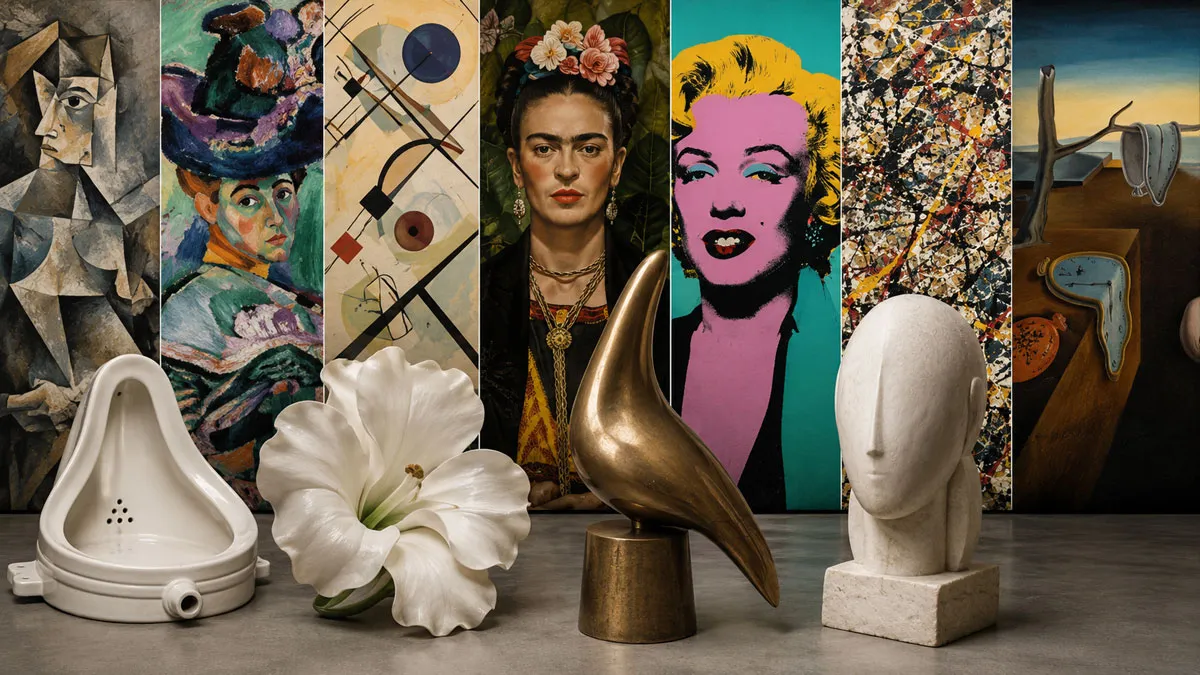
Modern art transformed the way artists approached color, form, perspective, materials, and even the definition of art itself. Rather than following established academic conventions, modern artists often experimented with new visual languages and responded to the rapidly changing world around them.
There is no single official list of the most famous modern artists. However, a number of figures have had an especially lasting presence in museums, art history, exhibitions, and popular culture. Among the most widely recognized are Pablo Picasso, Henri Matisse, Wassily Kandinsky, Marcel Duchamp, Frida Kahlo, Georgia O’Keeffe, Joan Miró, Salvador Dalí, Piet Mondrian, and Jackson Pollock.
The term “modern art” generally refers to art produced from the late 19th century through much of the 20th century. It includes movements such as Fauvism, Cubism, Expressionism, Dada, Surrealism, De Stijl, and Abstract Expressionism. Major museum collections continue to present these artists as central figures in the development of modern art.
The Most Famous Modern Artists At A Glance
| Artist | Associated Movement Or Approach | Known For |
| Pablo Picasso | Cubism | Radically rethinking form, perspective, and representation |
| Henri Matisse | Fauvism and modern painting | Expressive color, simplified forms, and cut-outs |
| Wassily Kandinsky | Abstract art | Using color and form independently of recognizable subjects |
| Marcel Duchamp | Dada and conceptual art | Questioning traditional definitions of an artwork |
| Frida Kahlo | Figurative modernism | Self-portraits, identity, symbolism, and Mexican visual culture |
| Georgia O’Keeffe | American modernism | Flowers, landscapes, abstraction, and distinctive close-up forms |
| Joan Miró | Surrealism and abstraction | Dreamlike imagery, symbols, lines, and vivid forms |
| Salvador Dalí | Surrealism | Highly detailed dream imagery and unexpected combinations |
| Piet Mondrian | De Stijl | Geometric compositions based on lines and primary colors |
| Jackson Pollock | Abstract Expressionism | Large-scale paintings created through energetic gestures and poured paint |
Pablo Picasso
Pablo Picasso is one of the most recognizable names in 20th-century art. Born in Spain in 1881, he spent much of his career in France and worked across painting, drawing, sculpture, printmaking, and other forms.
Picasso is particularly associated with Cubism, which he developed with Georges Braque. Cubist artists challenged conventional perspective by presenting objects through multiple viewpoints and breaking recognizable forms into geometric structures. Picasso’s long career also included very different periods and approaches, making his work difficult to reduce to a single style.
Works such as Les Demoiselles d’Avignon and Guernica have become major points in discussions of modern art. His influence extends across painting, sculpture, printmaking, and visual culture.
Henri Matisse
Henri Matisse was a French artist whose career helped redefine the possibilities of color and form. He is strongly associated with Fauvism, a movement known for intense, non-naturalistic colors and simplified forms.
Matisse did not remain confined to one medium. He worked as a painter, sculptor, draftsman, and printmaker, continually exploring the relationship between color and line. In the later part of his career, his paper cut-outs became especially important, allowing him to construct compositions directly from vividly colored shapes.
His approach demonstrated that color could perform more than a descriptive function. It could establish rhythm, structure, atmosphere, and emotion within an image.
Wassily Kandinsky
Wassily Kandinsky played a major role in the development of abstract art. Born in the Russian Empire in 1866, he eventually became associated with European avant-garde movements and the Bauhaus.
Kandinsky increasingly separated painting from the need to depict recognizable objects. Color, line, shape, and composition became subjects in their own right. His interest in the relationship between painting and music contributed to his belief that visual elements could communicate without directly representing the physical world.
His paintings helped establish abstraction as a major direction in modern art. Museums such as the Centre Pompidou continue to identify Kandinsky as one of the pioneers of abstraction.
Marcel Duchamp
Marcel Duchamp challenged one of the most basic assumptions about art: that an artwork must be a traditionally crafted object. His experiments with ordinary manufactured objects, particularly his readymades, shifted attention from artistic craftsmanship toward selection, context, authorship, and ideas.
His Fountain, presented in 1917 under the name R. Mutt, became one of the most discussed works in modern art. Duchamp’s contribution was especially important to the development of conceptual approaches to art, in which the idea behind a work can be more important than its physical appearance.
His influence can be seen far beyond Dada. Later generations of artists repeatedly returned to questions about what qualifies as art and who determines its meaning.
Frida Kahlo
Frida Kahlo is one of the most widely recognized artists associated with 20th-century Mexican art. Born in Mexico in 1907, she became particularly known for self-portraits that combine personal experience with symbolism, Mexican cultural , and carefully constructed imagery.
Kahlo’s paintings frequently turn the artist herself into the central subject. Her works explore identity, relationships, physical experience, heritage, and personal symbolism without separating these subjects neatly from one another.
Her distinctive visual language has contributed to her enduring international recognition. The Centre Pompidou’s collection, for example, includes The Frame, a 1938 self-portrait that demonstrates her use of Mexican decorative traditions and symbolism.
Georgia O’Keeffe
Georgia O’Keeffe was a major figure in American modernism. She is particularly famous for paintings of flowers, bones, landscapes, and architectural forms, often enlarged or simplified until they approach abstraction.
O’Keeffe developed a highly individual visual vocabulary. Her close-up flower paintings encouraged viewers to reconsider familiar natural forms by presenting them at an unfamiliar scale. Her later paintings of the American Southwest likewise became closely associated with her artistic identity.
Her importance extends beyond individual paintings. O’Keeffe helped establish a distinctive form of American modernism and became one of its most recognizable artists.
Joan Miró
Joan Miró developed a visual language filled with simplified figures, floating forms, lines, symbols, and vivid areas of color. Born in Barcelona in 1893, he became associated with Surrealism while maintaining an approach that was highly personal.
Rather than reproducing the physical world realistically, Miró often transformed recognizable elements into playful or dreamlike signs. His paintings, sculptures, ceramics, and prints demonstrate a continuing interest in reducing forms to essential visual marks.
His work illustrates how modern art could move between recognizable imagery and abstraction without belonging entirely to either category.
Salvador Dalí
Salvador Dalí became one of the best-known representatives of Surrealism. His paintings often combine technically precise rendering with impossible situations, distorted objects, unusual landscapes, and dreamlike imagery.
Dalí’s distinctive style made Surrealism accessible to a broad public while also establishing a strong personal identity. His best-known works demonstrate how familiar objects can become strange when their scale, context, or physical behavior is altered.
Although Dalí worked in several media, his meticulously painted images remain the foundation of his reputation as a modern artist.
Piet Mondrian
Piet Mondrian pursued an increasingly reduced form of abstraction. His mature compositions are characterized by straight horizontal and vertical lines, rectangular areas, and carefully balanced blocks of color.
As a leading figure associated with De Stijl, Mondrian sought a visual order that moved away from direct representation. His familiar compositions featuring black lines and areas of primary colors became influential not only in painting but also in architecture, design, and visual culture.
Mondrian’s work demonstrates how a seemingly simple composition can result from a sustained investigation of proportion, balance, space, and color.
Jackson Pollock
Jackson Pollock became a central figure in American Abstract Expressionism. His large canvases often contain networks of dripped, poured, and splattered paint rather than conventional images or carefully defined objects.
Pollock’s technique placed considerable emphasis on the physical process of making a painting. Instead of applying paint exclusively with a brush to an upright canvas, he frequently worked around paintings positioned horizontally, allowing paint to fall, flow, and accumulate across the surface.
The resulting works shifted attention toward gesture, movement, rhythm, and the physical act of painting itself.
Why These Artists Remain Famous
The lasting fame of modern artists is not based on one common style. In fact, their approaches are remarkably different. Picasso fragmented forms, Matisse explored color, Kandinsky pursued abstraction, Duchamp questioned artistic conventions, Kahlo transformed autobiography into imagery, and Mondrian reduced compositions to geometric relationships.
Several factors help explain their continuing visibility:
- Distinctive visual languages: Their work can often be recognized from a small selection of characteristic features.
- Influence on later artists: Their ideas and techniques provided foundations for subsequent movements and practices.
- Museum representation: Major international collections continue to preserve and exhibit their work.
- Cultural reach: Their imagery has moved beyond galleries into books, education, design, fashion, film, and popular culture.
- Historical importance: Their careers are closely connected to major changes in the development of modern art.
Modern Art And Contemporary Art Are Not The Same
The terms modern art and contemporary art are sometimes used interchangeably in everyday conversation, but they generally refer to different periods. Modern art is primarily associated with the late 19th and 20th centuries, particularly the period in which artists challenged traditional academic approaches and developed new movements.
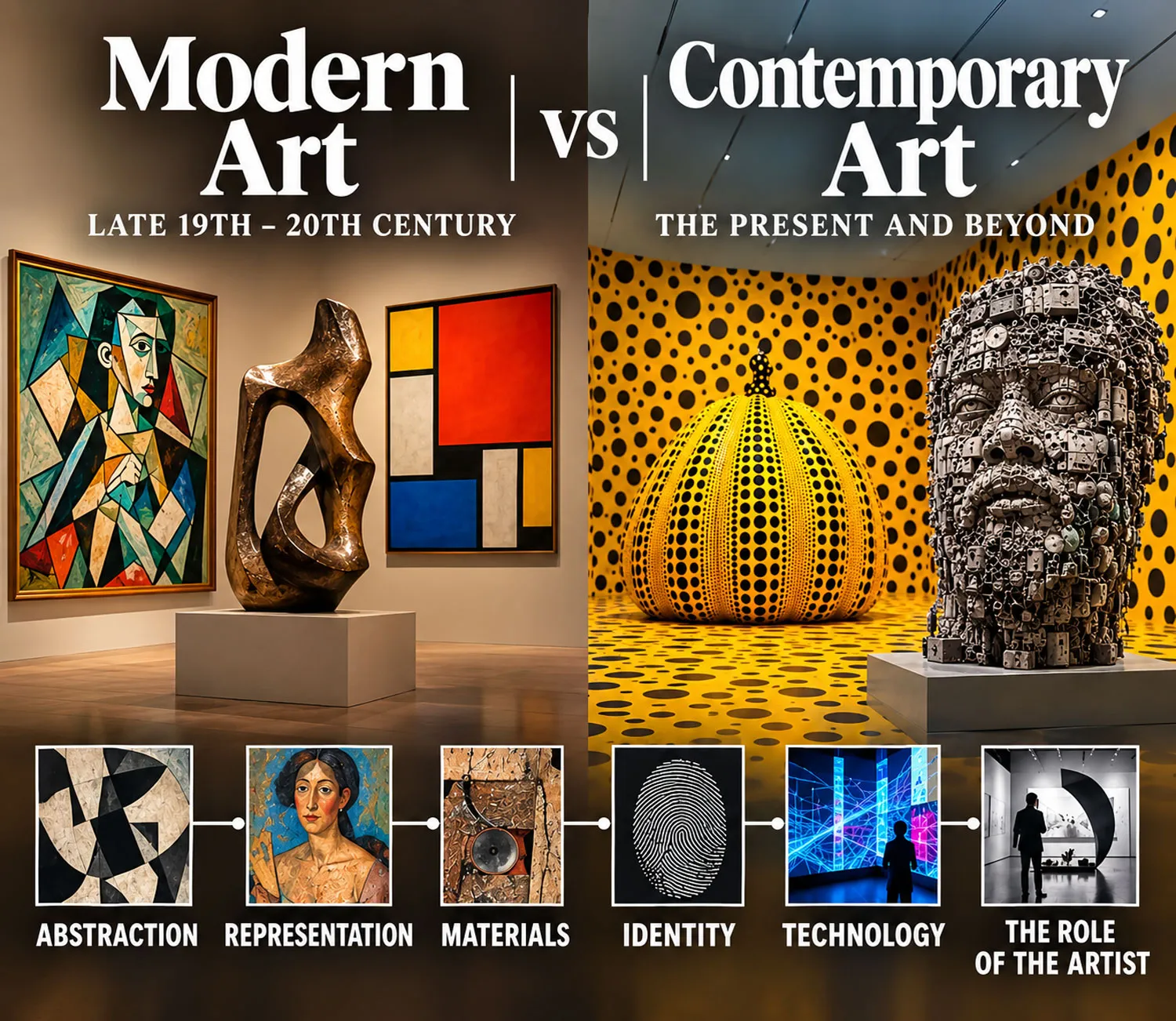
Contemporary art generally refers to art produced in the more recent and current period. Artists such as Yayoi Kusama and Ai Weiwei are therefore usually discussed within contemporary rather than historical modern art, even though their practices are connected to ideas developed by earlier modernists.
This distinction matters because the history of modern art is not simply a list of famous painters. It is a sequence of overlapping experiments in abstraction, representation, materials, identity, technology, and the role of the artist.
A Legacy That Continues Across Art Forms
The most famous modern artists changed more than painting. Their experiments influenced sculpture, photography, graphic design, architecture, performance, installation, and later conceptual practices. Their work also demonstrated that art could question established assumptions rather than simply reproduce the visible world.
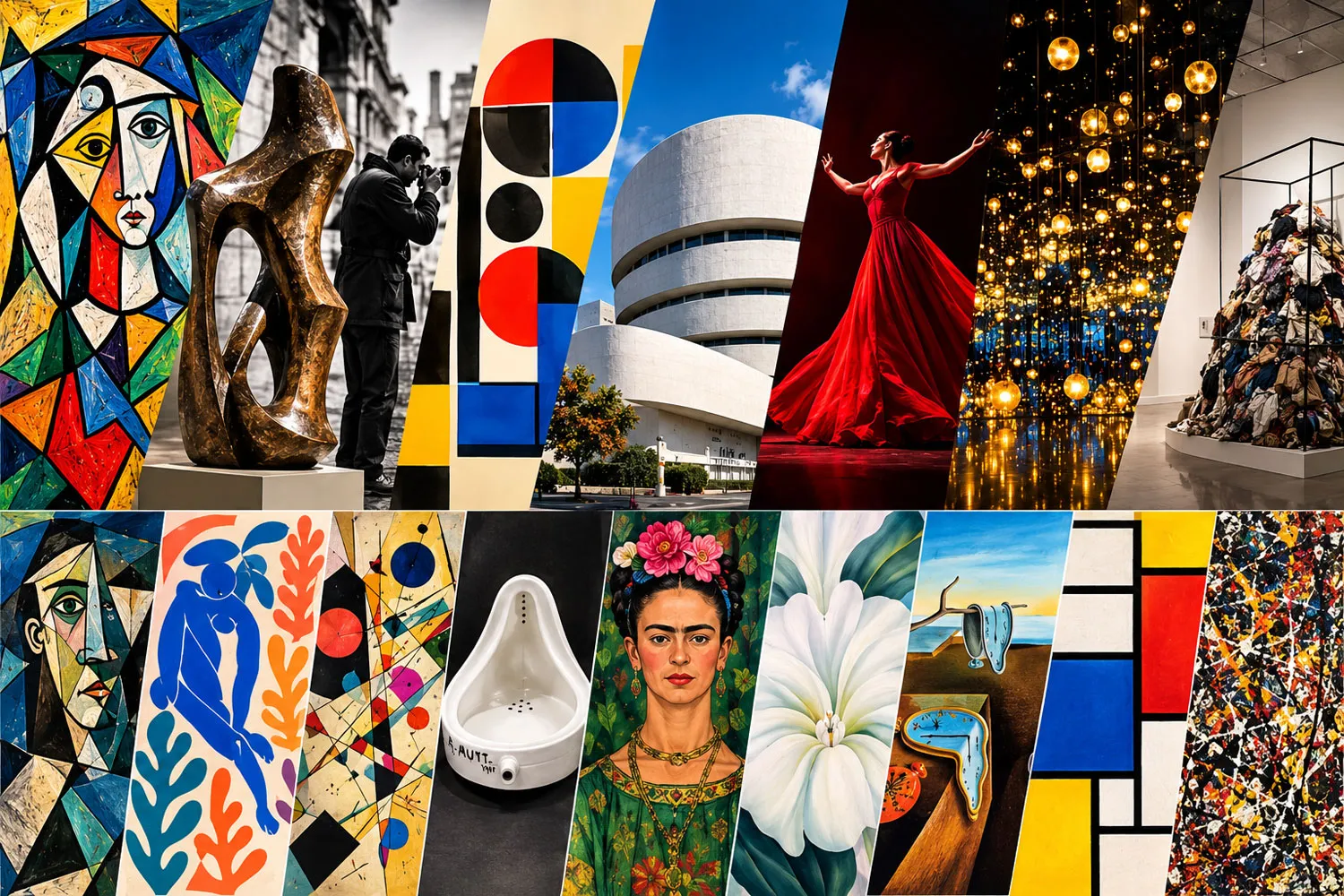
From Picasso’s fractured perspectives to Matisse’s liberated color, Kandinsky’s abstraction, Duchamp’s conceptual challenges, Kahlo’s self-portraiture, O’Keeffe’s modern landscapes, Miró’s symbolic forms, Dalí’s Surrealist imagery, Mondrian’s geometric order, and Pollock’s physical gestures, modern art encompasses an extraordinary range of ideas.
That diversity is one reason these artists remain central to the story of 20th-century art. Their individual styles were very different, but each contributed to a broader transformation in how artists could see, create, and define art.