
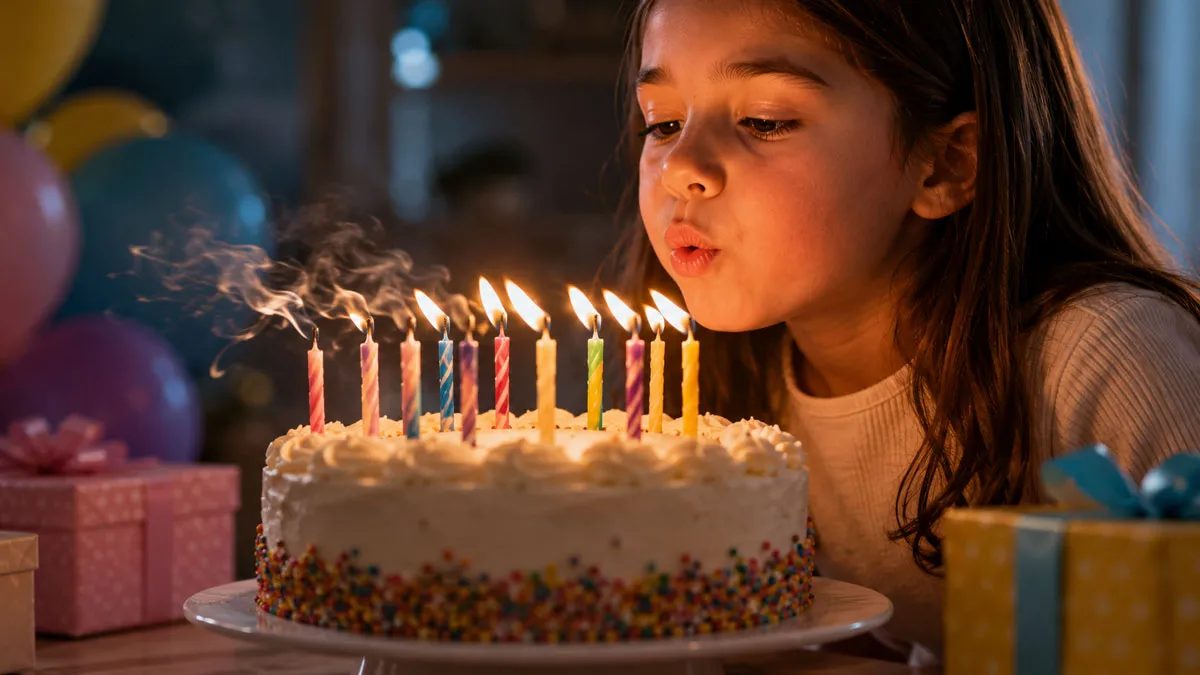
Blowing out birthday candles seems like one of the simplest rituals in the world: a cake arrives, candles are lit, everyone sings, the birthday person makes a wish, and one breath sends the flames into darkness. Yet this familiar moment combines several older traditions involving light, celebration, wishes, and the marking of another year of life.
The exact origin of blowing out birthday candles is not known. Several customs developed over different periods and eventually came together to create the birthday ritual familiar today.
How Birthday Candles Became Part Of The Celebration
Candles have been used in celebrations and religious ceremonies for centuries. Their symbolic associations with light, hope, remembrance, and prayer helped make them natural additions to special occasions. However, there is no reliable evidence showing that people in ancient times regularly celebrated ordinary birthdays by placing candles on cakes and blowing them out.
One important part of the story comes from German-speaking Europe. By the 18th century, birthday celebrations for children could include a cake decorated with candles representing the child’s age. Historical accounts describe candles being placed on cakes as part of these celebrations, although the precise meaning and number of candles varied.
Over time, birthday cakes and candles became increasingly common beyond their original cultural settings. Improvements in candle-making, baking, and household prosperity also made the practice easier for more families to adopt.
Why Do We Make A Wish Before Blowing?
The wish is closely connected to the act of extinguishing the candles, but the historical connection is less certain than popular stories sometimes suggest. There is no single documented event that established the modern rule that a birthday person must make a wish and then blow out all the candles in one breath.
Instead, the custom appears to have developed as birthday celebrations evolved. A burning candle creates a natural moment of attention: everyone watches the flame, the birthday person silently makes a wish, and the wish is followed by a single deliberate action.
The ritual can be understood as a symbolic sequence:
- Lighting the candles creates a visible focal point for the celebration.
- Making a wish gives the birthday moment a personal meaning.
- Blowing out the flames completes the ritual.
- Sharing the cake turns the private wish into a communal celebration.
What Does Blowing Out The Candles Symbolize?
There is no universally accepted symbolic meaning behind the act of extinguishing birthday candles. Different explanations have been attached to the practice over time, but they should not be confused with established historical facts.
Today, blowing out the candles is primarily a celebratory tradition. It marks a transition from the anticipation of the birthday moment to the rest of the celebration. The flames disappear, the guests applaud, and the cake is ready to be served.
| Part of the ritual | Common role today |
| Candles | Represent the birthday person’s age or simply decorate the cake |
| Wish | Provides a private, personal moment |
| Blowing | Marks the end of the candle-lighting ritual |
| Cake | Brings the group together to share the celebration |
Why Are There Candles On A Birthday Cake?
The connection between candles and birthdays is partly practical and partly symbolic. Candles transform an ordinary cake into something associated with a particular occasion. As birthday celebrations became more elaborate, they provided an easy way to make the cake visually distinctive.
For many people, the number of candles also has an obvious connection to age. A child turning six might receive a cake with six candles, while adults often use fewer candles for convenience or replace individual candles with a numbered decoration.
The tradition therefore does not depend on one fixed arrangement. The candles can represent age, celebration, or simply the familiar appearance of a birthday cake.
Is The Tradition Really From Ancient Greece?
A popular explanation connects birthday candles with ancient Greek offerings to the goddess Artemis. Ancient Greeks did use cakes and candles in religious contexts, and light had important ceremonial associations. However, this does not establish a direct historical line from those practices to the modern birthday cake.
The ancient Greek tradition and the modern birthday-candle ritual are separated by many centuries and very different cultural settings. Similarities involving cakes, candles, and celebrations can be interesting without proving that one custom directly evolved from the other.
This distinction matters because birthday traditions are often explained through attractive historical stories that are repeated for years even when the surviving evidence is incomplete.
How The Modern Birthday Ritual Took Shape
The birthday celebration familiar today is the result of several traditions developing and spreading over time rather than the invention of a single person or culture.
As birthday parties became increasingly popular, cakes became central to the occasion. Candles added decoration and a memorable activity, while songs and group participation turned the lighting and extinguishing of the candles into a shared performance.
The result is a remarkably consistent sequence that can be recognized in many places:
- The birthday cake is brought to the group.
- The candles are lit.
- Guests sing a birthday song.
- The birthday person makes a wish.
- The candles are blown out.
- The cake is cut and shared.
Not every culture follows this sequence, and birthday celebrations differ widely around the world. Nevertheless, the candle-blowing ritual has become particularly recognizable in countries where the modern Western-style birthday party is common.
Why Do We Try To Blow Them Out In One Breath?
Trying to extinguish every candle with one breath adds a small challenge to the ceremony. It also makes the moment more dramatic: everyone watches to see whether the flames disappear at once.
The idea that successfully blowing out all the candles guarantees that a wish will come true is best understood as folklore rather than a historical fact. There is no scientific evidence that blowing out birthday candles affects whether a wish comes true.
That does not make the custom meaningless. Rituals often survive because they create shared experiences. The value of the moment comes from the people participating in it, not from a supernatural mechanism.
Why The Tradition Has Lasted
Birthday candles combine several things that make a ritual easy to remember. They are visual, brief, participatory, and connected to a personal milestone. Even very young children can understand the basic sequence and take part in it.
There is also a social reason for its persistence. Everyone at the celebration temporarily focuses on one person. The candles provide a clear beginning and end to that moment, while the cake gives everyone something to share afterward.
So, why do we blow out birthday candles? Because a number of older traditions involving candles, cakes, celebration, wishes, and birthdays gradually came together. The precise origin of the modern ritual cannot be traced to one definitive source, but its basic form has become one of the world’s most recognizable birthday customs.
Today, the flames disappear in just a few seconds. The tradition behind them, however, reflects centuries of changing ideas about celebration, community, and marking another year of life.