
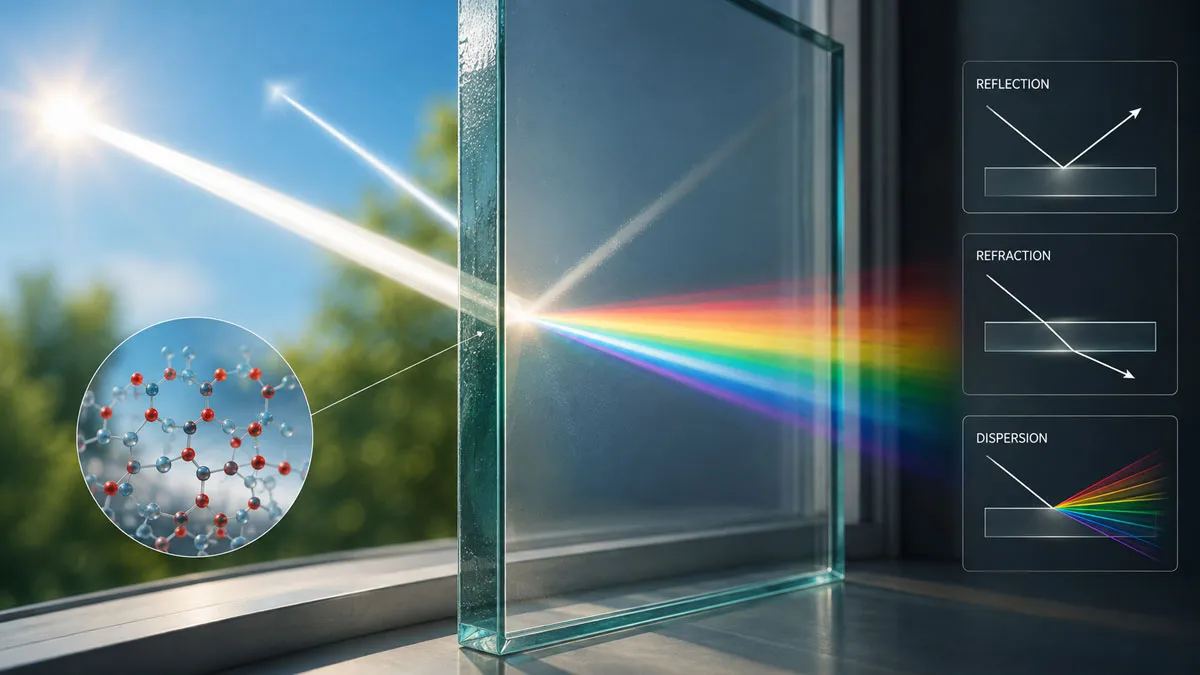
A pane of ordinary glass allows visible light to pass through while remaining a rigid solid. This unusual combination comes from the way glass interacts with light at the atomic and electronic levels. Its composition gives visible-light photons too little energy to trigger strong electronic absorption, while its relatively uniform structure limits the scattering that would otherwise make a material look cloudy.
Transparency therefore does not mean that light simply encounters empty spaces between atoms. Instead, it means that, within the relevant range of wavelengths, absorption and scattering are sufficiently weak for most of the incoming visible light to continue through the material.
How Light Interacts With Glass
Light can interact with matter in several ways. At a simple level, some of the incoming light can be reflected at the surface, some can be absorbed by the material, and the remainder can be transmitted through it. Scattering can also redirect light away from its original path.
Glass appears transparent because visible wavelengths encounter relatively few mechanisms that strongly remove them from the transmitted beam. A small amount of reflection still occurs at every glass surface, which is why a window is not perfectly invisible.
The most important part of the explanation lies in the energy carried by visible photons and the allowed energy states of electrons within the glass.
The Electronic Structure Is Central To Transparency
Electrons in a solid occupy specific ranges of allowed energy. A photon can be absorbed when its energy is appropriate for an allowed transition, such as moving an electron from a lower-energy state to a higher-energy state.
The chemical bonds in common silica-based glasses create a large separation between the occupied electronic states and higher-energy states that electrons could enter. This separation is commonly described in terms of an electronic or optical band gap.
Visible light does not normally have enough energy to produce the strong electronic transitions that would absorb it in ordinary clear glass. Much higher-energy ultraviolet radiation can interact with these electronic states, so glass generally becomes much less transparent toward the ultraviolet part of the spectrum.
| Interaction | What Happens In Typical Clear Glass |
|---|---|
| Visible light | Strong electronic absorption is generally weak, allowing substantial transmission. |
| Ultraviolet light | Higher photon energies can reach electronic absorption processes, reducing transmission. |
| Infrared radiation | Vibrations of the atoms and chemical bonds can absorb particular infrared wavelengths. |
This is why it is more accurate to say that glass has a useful transmission window than to say that glass is transparent to all light.
Why The Amorphous Structure Matters
Most everyday glass is an amorphous solid. Its atoms form a connected network but do not possess the long-range periodic arrangement found in a conventional crystal.
This structure is important because clear glass can be relatively uniform on the scale relevant to visible wavelengths. It does not contain the numerous crystal grains and grain boundaries that can cause substantial scattering in many polycrystalline materials.
However, the statement that glass is transparent simply because it is amorphous is misleading. The electronic structure and chemical composition are fundamental to its transparency. Some crystalline materials are also transparent, while some amorphous materials are opaque. Transparency depends on the combined effects of absorption, scattering, composition, and structure.
Why Sand Is Not As Clear As Glass
Silica is an important component of many glasses, so it may seem strange that a transparent window can be made from a material associated with opaque sand.
The difference is largely structural. A piece of sand contains many small particles, surfaces, defects, impurities, and interfaces. Light entering such a collection of particles is repeatedly scattered in different directions. Even if the individual silica material can transmit light, the overall sample may therefore appear white, cloudy, or opaque.
When silica-containing material is melted and formed into a continuous glass, the separate interfaces between grains are removed. A sufficiently homogeneous piece can then transmit visible light much more effectively.
Why Glass Can Still Reflect And Distort Light
Transparency does not mean that light travels through glass exactly as it would through empty space. When light crosses from air into glass, its speed and direction change because the electromagnetic field interacts with the material.
This change in direction is called refraction. It is responsible for familiar effects such as the apparent displacement of an object viewed through a thick glass surface.
Glass also reflects part of the incoming light at its surfaces. Under ordinary conditions, this reflection is relatively small compared with the transmitted portion, which is why a clean window can still appear clear.
Why Some Glass Is Colored Or Cloudy
Not every type of glass transmits visible light equally well. Its optical behavior depends on its chemical composition, purity, thickness, and physical structure.
- Coloring substances can introduce absorption in parts of the visible spectrum.
- Impurities and defects can create additional absorption or scattering.
- Particles and inclusions can scatter light and make glass appear cloudy.
- Greater thickness gives light more material through which it must travel, increasing the cumulative effect of absorption and scattering.
A colored pane therefore does not necessarily fail to transmit light. It may transmit some visible wavelengths efficiently while absorbing others. The wavelengths that survive determine the color perceived by an observer.
Why Glass Is Not Transparent To Every Type Of Light
The same material can behave very differently at different wavelengths because photon energy depends on wavelength. Shorter-wavelength radiation carries more energy, while longer-wavelength radiation carries less.
At short wavelengths, electronic absorption becomes important. At sufficiently long wavelengths, the vibrations of atoms and chemical bonds can absorb radiation. Between these absorption regions, certain glasses have a range in which light can travel comparatively efficiently.
This wavelength dependence explains why calling glass simply “transparent” is incomplete. Transparency is always relative to a particular range of electromagnetic radiation and to the composition and thickness of the material.
The Simple Explanation
At the most useful level, the answer can be reduced to three connected ideas:
- Visible photons generally cannot drive strong electronic transitions in ordinary clear glass.
- The amorphous, relatively homogeneous structure limits the internal scattering that would otherwise redirect visible light.
- Glass still reflects, refracts, absorbs, and scatters some radiation, so its transparency is substantial rather than perfect.
Thus, a window is transparent not because light passes through large empty spaces between atoms, but because the material’s electronic energy structure and physical uniformity allow visible light to propagate through it with relatively little absorption or scattering.