

Price comparison websites bring offers from different sellers into one place so shoppers can compare products, prices, and buying conditions. Instead of visiting each retailer separately, a shopper can search for an item and review several offers on a single page.
The process looks simple on the surface, but several systems work behind it. Comparison sites collect product information, match similar offers, update prices and availability, rank results, and send shoppers to sellers when they are ready to buy. Their business model can also affect how products appear.
What A Price Comparison Website Does
A price comparison website acts as an intermediary between shoppers and sellers. It usually does not own the products shown in its results. Instead, it gathers information supplied by merchants or collected from their online stores and presents that information in a comparable format.
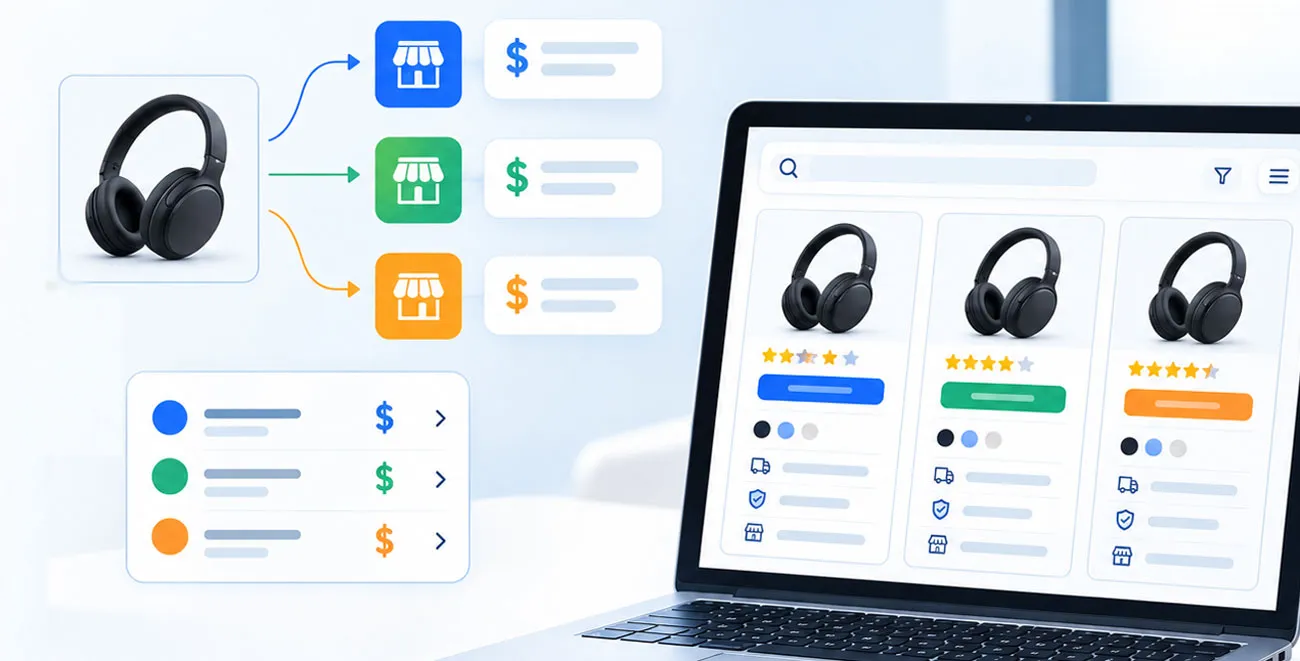
Google describes comparison shopping services as websites that collect product offers from different merchants and let users compare prices and features. This basic model applies to many comparison platforms, although individual sites can use different data sources, ranking systems, and commercial arrangements.
A typical comparison service brings together information such as:
- Product name, brand, and model
- Price and available offers
- Product variations such as size or color
- Availability information
- Shipping or delivery details when available
- Seller information
The site then organizes this information so that similar offers can be viewed side by side.
How Price Comparison Websites Collect Product Data
The first major part of the process is data collection. A comparison service needs accurate information from participating sellers before it can display meaningful comparisons.
Merchant Feeds And Direct Data
Many retailers send structured product data to shopping platforms. A feed can contain information about products, prices, availability, identifiers, and other attributes. Comparison services can process this information and update their listings when the retailer changes its data.
Some services also use technical connections such as APIs. An API can transfer structured information between systems without requiring someone to enter every product manually.
Another method is automated website crawling. In this model, software retrieves information from retailer websites and extracts relevant product details. The exact methods vary between services.
| Data source | How It Works | Typical Use |
|---|---|---|
| Merchant feed | The retailer sends structured product information. | Prices, products, and availability |
| API connection | Systems exchange structured data electronically. | Frequent or automated updates |
| Website crawl | Automated software retrieves information from retailer pages. | Collecting publicly available offer data |
The quality of the comparison depends heavily on the quality and freshness of this data. A displayed price may become inaccurate if a retailer changes its offer before the comparison service receives or processes the update.
How Different Offers Are Matched
Collecting prices is not enough. The system must determine which offers refer to the same product.
Product identifiers are particularly important for this task. A manufacturer part number, model number, or other product identifier can distinguish one product from another. Other attributes, such as brand, product title, size, color, and technical specifications, can also be used.
This distinction matters because two products can look similar while having different specifications. A comparison that groups different models together could give shoppers a misleading impression of the available prices.
Product variations create another challenge. A retailer may sell the same basic product in several sizes, colors, storage capacities, or configurations. A reliable comparison must account for those differences rather than treating every variation as an identical offer.
How Prices Are Compared
Once offers have been collected and matched, the website can place them into a common comparison format.
The simplest comparison sorts offers by the listed product price. More useful comparisons consider other costs as well. The Federal Trade Commission advises shoppers to consider the total cost, including shipping, handling, taxes, and other applicable fees.
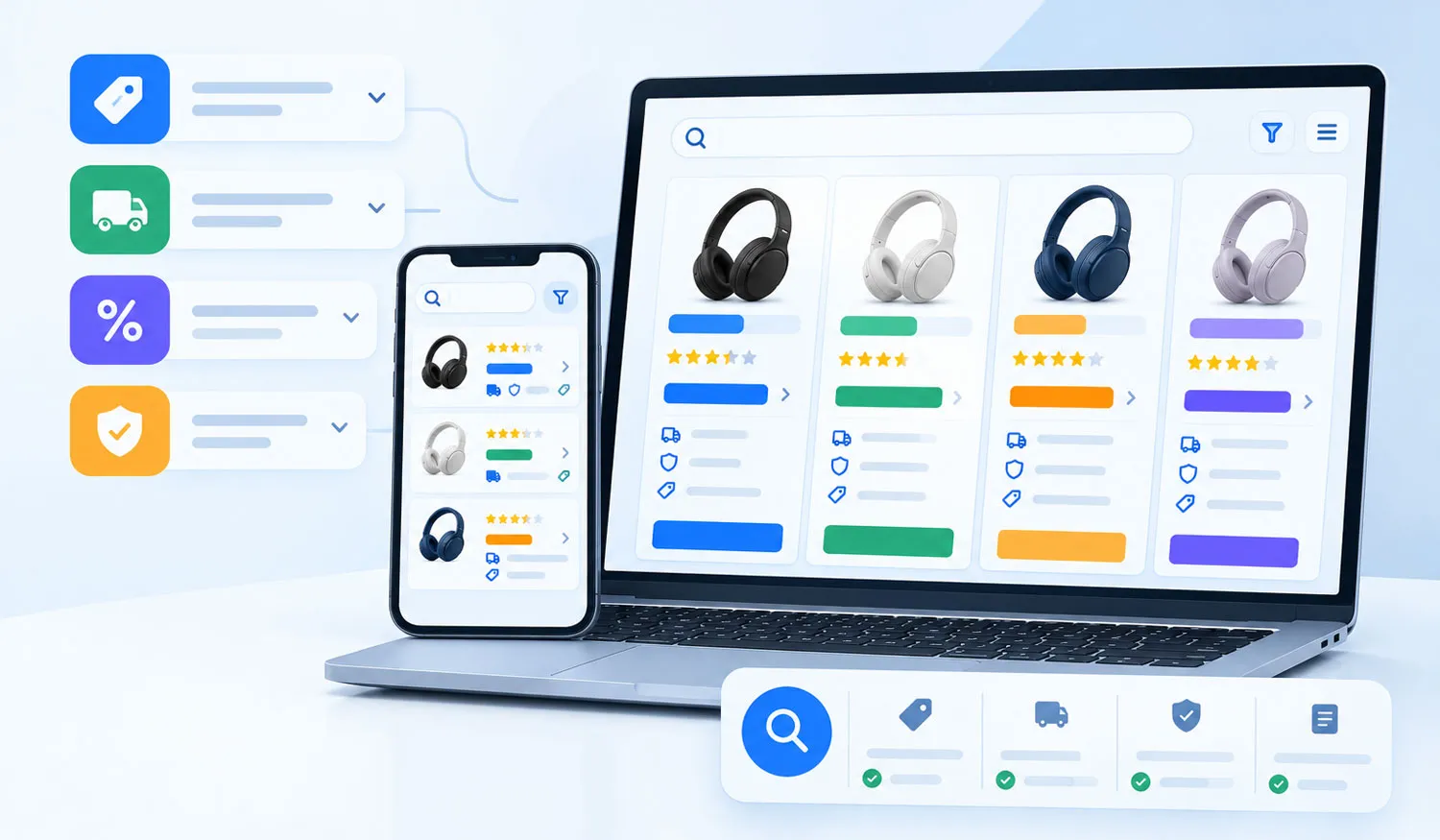
This distinction is important because the lowest displayed product price is not always the lowest final price. A seller with a slightly higher item price may have lower delivery costs or different fees.
Price comparison systems may also distinguish between different types of prices. For example, a product can have a standard price, a discounted price, or a member-only price. A comparison is meaningful only when shoppers can understand the conditions attached to each offer.
How Results Are Ranked
A comparison website does not always display offers in simple price order. The ranking system depends on the individual platform.
Possible ranking factors include price, relevance to the search, product information, seller information, availability, shipping details, and commercial arrangements. Some platforms may also display sponsored or paid placements.
This creates an important distinction between the cheapest offer and the first offer shown. They are not necessarily the same.
The Federal Trade Commission has warned that some comparison and review websites have used payment arrangements that affected rankings or placement. Consumers should therefore check how a comparison site earns money and whether it identifies paid placements clearly.
How Comparison Websites Make Money
Comparison websites need a business model to operate their technology, data systems, and commercial relationships. Different services use different models.
Pay-Per-Click Models
In a pay-per-click arrangement, a merchant or advertising partner pays when a shopper clicks an eligible listing or advertisement. The exact pricing structure depends on the agreement between the parties.
Google’s documentation for comparison shopping services describes models in which merchants can be charged on a per-click basis. It also describes arrangements where a service receives a commission when a click leads to a sale.
Commission-Based Models
Some comparison sites earn a commission when a shopper follows a tracked link and completes a purchase with a retailer. This is commonly known as affiliate marketing.
A commission does not automatically mean that a comparison is unreliable. However, the commercial relationship can matter when a website makes recommendations or presents rankings as independent. The FTC states that affiliate relationships should be disclosed clearly and conspicuously when they could affect how consumers evaluate an endorsement.
Advertising And Sponsored Placement
Some comparison services also generate revenue from advertising or paid placement. These arrangements can place commercial offers in prominent positions without changing the underlying price offered by the retailer.
For shoppers, the key point is simple: prominence does not always mean superiority. A highly visible result may reflect advertising, relevance, or another ranking factor rather than the lowest price.
What Happens When You Click An Offer
A comparison website often does not complete the purchase itself. Instead, clicking an offer may take the shopper to the retailer’s website, where the retailer handles the transaction.
The retailer then controls important parts of the purchase, including payment, order fulfillment, shipping, returns, and refunds. This is different from an online marketplace, where the platform may have a more direct role in transactions between buyers and sellers.
Before completing a purchase, shoppers should check the seller’s product page rather than relying only on the information shown by the comparison service. Prices, availability, delivery charges, and other terms can change between the comparison page and checkout.
Why The Lowest Price May Not Be The Best Deal
A comparison based only on the headline price can leave out important parts of the purchase.
Consider these factors before choosing an offer:
- Total price after shipping, taxes, and applicable fees
- Exact product model and specifications
- Product condition, such as new or refurbished
- Delivery terms and estimated arrival time
- Return and refund conditions
- Seller reputation and contact information
- Warranty or other applicable purchase terms
The Federal Trade Commission specifically advises consumers to read the complete deal terms and check shipping, return, refund, and other conditions before buying online.
Why Prices Can Differ Between Comparison Sites And Retailers
A comparison result is based on information available to the service at a particular point in time. Retailers can change prices, stock levels, shipping charges, and promotions.
Data transmission can also introduce delays. A retailer may update its store before the comparison service receives the new information. Some product data can also depend on location, membership status, selected product variations, or other conditions.
For these reasons, a comparison website should be treated as a shopping research tool, not as a guarantee that every displayed offer remains available at checkout.
How To Use Price Comparison Websites Effectively
A good comparison process combines the website’s information with a final check at the seller’s store.
- Identify the exact product model and required specifications.
- Compare several sellers rather than relying on the first result.
- Check the total cost, not only the advertised item price.
- Read the seller’s shipping, return, and refund terms.
- Check whether the listing is sponsored or connected to a commercial relationship.
- Confirm the final price and product details on the retailer’s website before paying.
It is also worth checking the retailer directly. The Federal Trade Commission recommends comparing sellers and products across multiple sources and warns consumers not to rely solely on comparison-site prices or ratings.
What Price Comparison Websites Can And Cannot Tell You
These services are particularly useful for finding differences between competing offers. They can reduce the amount of time needed to search multiple stores and can bring scattered product information into one view.
They cannot guarantee that every seller is equally trustworthy, that every price is current, or that the cheapest listing represents the best overall purchase.
A comparison site also cannot replace the retailer’s own terms. The retailer remains the source to check for the final transaction details, including the exact product, payment conditions, delivery terms, and return policy.
The Main Idea Behind Price Comparison Websites
At their core, price comparison websites are data aggregation systems. They gather offers from multiple sellers, identify comparable products, organize the information, and present the results in a form that shoppers can evaluate.
The process can be summarized as collect, match, organize, rank, and refer. The service collects product data, matches related offers, organizes prices and product details, ranks results according to its system, and often sends the shopper to a retailer to complete the purchase.
The most useful comparison is not simply the one with the lowest number. A sound decision considers the exact product, total cost, seller, delivery terms, return policy, and any commercial relationship that may affect how an offer is presented.