
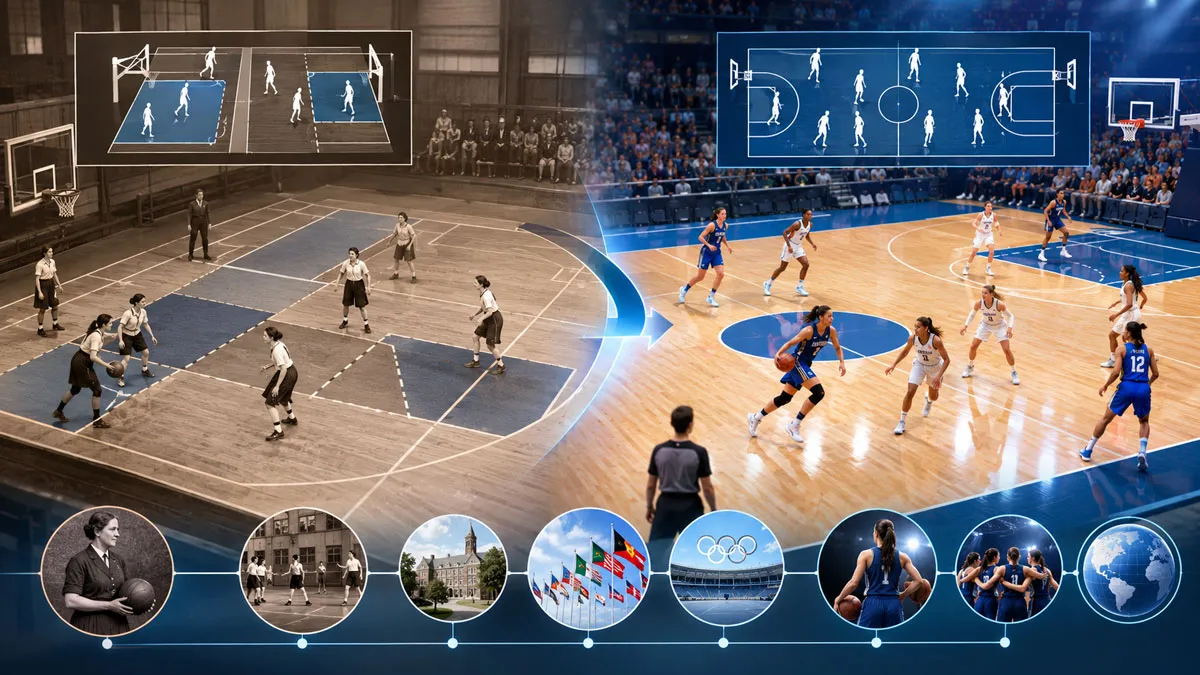
Women’s basketball has developed from an early adaptation of the sport into a highly organized form of competition played at school, university, professional, and international levels. Its history reflects changes in sporting rules, access to education, opportunities for women in organized athletics, and the gradual expansion of international competition. The modern game retains the basic principles of basketball while featuring its own long sporting tradition and institutions.
Early Foundations Of The Women’s Game
Basketball was invented in 1891 by James Naismith at the International YMCA Training School in Springfield, Massachusetts. Women began playing the sport soon afterward. One of the earliest documented women’s games took place in 1892 at Smith College, where physical education instructor Senda Berenson adapted the new sport for her students.
Berenson introduced rules intended to make the game suitable for the physical education environment of the period. Early women’s basketball therefore differed substantially from the modern version. Players were often restricted to particular areas of the court, and movement and possession were controlled more strictly than they are today.
These restrictions reflected contemporary ideas about women’s physical activity rather than limitations inherent in basketball itself. As women’s participation in organized sport expanded, the rules and structure of the game gradually changed.
From Educational Activity To Organized Competition
Schools and colleges played an important role in establishing women’s basketball. Physical education programs provided facilities, instruction, and organized opportunities for women to participate at a time when access to competitive sport was often limited.
During the early decades of the twentieth century, different regions and organizations used different versions of the rules. This variety allowed the sport to spread while also producing differences in playing style and competition structure.
International organization became increasingly important as basketball expanded beyond North America. The International Basketball Federation, commonly known as FIBA, was established in 1932. Women’s basketball subsequently became part of the federation’s international competitions, helping create a more consistent framework for the sport.
Important Stages In The Development
| Period | Development | Significance |
|---|---|---|
| 1890s | Women begin adopting basketball in educational settings | The sport becomes an organized activity for women |
| Early 20th century | Schools, colleges, and community organizations expand participation | Competition becomes more established |
| 1930s | International administration of basketball becomes more organized | A foundation develops for international women’s competition |
| 1970s | Women’s basketball gains greater institutional support in several countries | Participation and competitive opportunities expand |
| 1990s onward | Professional and international women’s competitions become increasingly prominent | The modern women’s basketball structure takes shape |
The Growth Of International Women’s Basketball
International competition became one of the major forces behind the sport’s development. FIBA organized the first Women’s World Championship in 1953, providing a major international tournament specifically for women’s national teams.
Women’s basketball also became part of the Olympic program. The sport made its Olympic debut for women at the 1976 Montreal Games. Olympic participation gave national teams an important international platform and contributed to the wider recognition of women’s basketball.
International competition helped establish common standards for playing rules, officiating, coaching, and tournament organization. It also created opportunities for players and teams from different basketball traditions to compete against one another.
Institutional Change And Wider Participation
The development of women’s basketball was closely connected to broader changes in education and organized sport. In the United States, Title IX, enacted in 1972, prohibited sex discrimination in education programs receiving federal financial assistance. Its application to athletics contributed to a substantial expansion of opportunities for girls and women in educational sports.
The effect of institutional support extended beyond the number of participants. More organized programs meant greater demand for coaches, officials, facilities, competitions, and pathways from youth basketball to higher levels of play.
Similar developments occurred in different forms elsewhere. National federations, schools, universities, clubs, and community organizations helped create structures through which girls could begin playing at younger ages and continue competing as they progressed.
Factors That Supported Expansion
- Greater access to organized physical education and school sports.
- Expansion of national and international basketball organizations.
- More opportunities for girls and women to enter structured competitions.
- Development of coaching and officiating systems.
- Growth of professional and international competitions.
The Emergence Of Professional Women’s Basketball
Professional women’s basketball developed gradually rather than through a single worldwide transition. Various leagues and clubs operated in different countries, with their structures shaped by local sporting systems and economic conditions.
In the United States, the Women’s National Basketball Association was established in 1996 and began play in 1997. The league provided a durable professional platform for elite women’s players and became an important part of the development of the sport in North America.
Professional leagues in other countries have also contributed to the international movement of players and coaches. These competitions have helped create professional pathways between domestic leagues, national teams, and international tournaments.
How The Modern Game Differs From Its Early Form
The contrast between early women’s basketball and the modern game is particularly clear in the rules and style of play. Early versions often restricted players to sections of the court and emphasized controlled movement. Modern basketball is played across the full court, with rapid transitions between offense and defense.
Contemporary players also benefit from advances in athletic training, sports science, nutrition, equipment, coaching methods, and video analysis. These developments have contributed to faster and more technically sophisticated play.
The evolution of the rules has therefore been more than a technical adjustment. It has accompanied a broader transformation in how women’s athletic ability and competitive sport have been understood and supported.
The Continuing Development Of The Sport
Women’s basketball now exists across a broad competitive pathway, from youth and school programs to university competition, professional leagues, and international championships. The growth of these interconnected levels has made it possible for more players to develop their skills over longer periods.
The history of the sport also demonstrates that its development has depended on both sporting innovation and institutional opportunity. Changes in rules made the game more dynamic, while schools, governing bodies, leagues, and international competitions created structures in which players could participate and advance.
Women’s basketball has consequently evolved from an early educational adaptation into a global competitive sport. Its development is best understood as a long process shaped by changing rules, expanding participation, stronger institutions, and increasing opportunities for women to compete at the highest levels.