
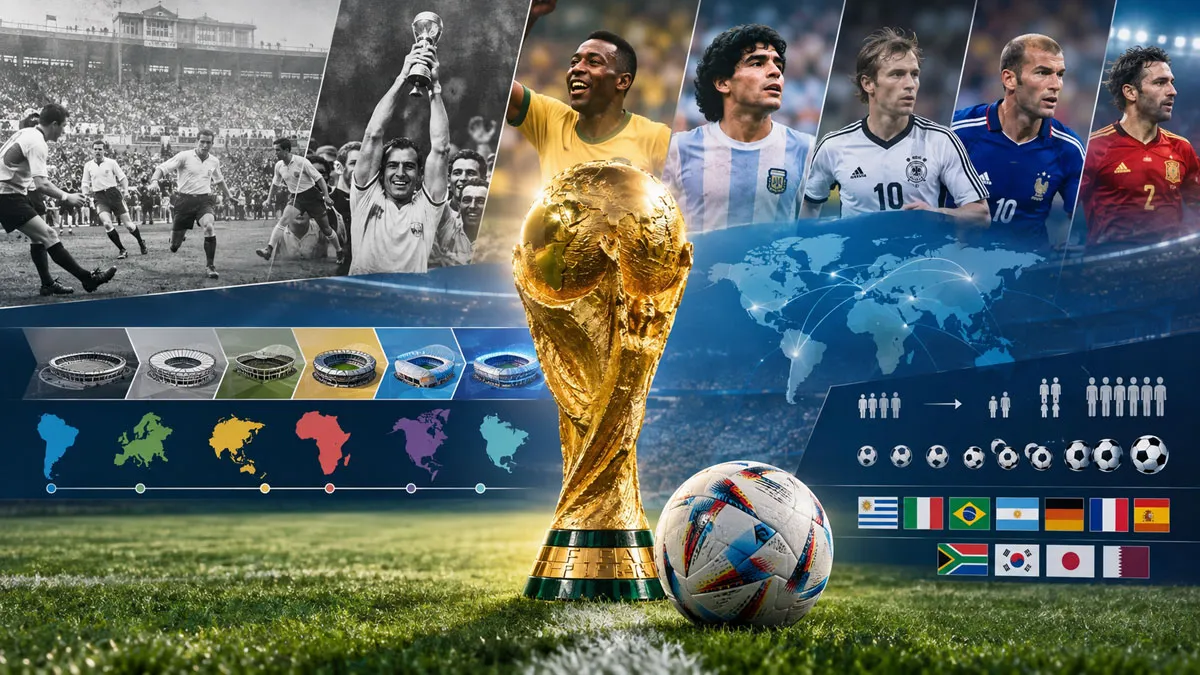
The FIFA World Cup has developed from a small international football tournament into one of the most significant sporting competitions in the world. Its history reflects changes in international football, tournament organization, technology, tactics, and the growing participation of nations from different regions. Since the first competition in 1930, the tournament has passed through periods of expansion, interruption, innovation, and remarkable sporting achievement.
The Origins Of The World Cup
Before the World Cup was established, international football was closely associated with the Olympic Games. FIFA, founded in 1904, eventually sought to create a competition specifically for national football teams. FIFA president Jules Rimet was an important figure in turning that idea into reality.
The first FIFA World Cup was held in Uruguay in 1930. Thirteen national teams participated, and all matches were played in Montevideo. Uruguay won the inaugural tournament by defeating Argentina 4–2 in the final.
The first competition established several features that became central to the tournament’s identity: national teams representing their countries, qualification through international competition, a host nation, and a final that determined the world champion.
The Early Tournaments
The second World Cup took place in Italy in 1934 and introduced a different competitive structure. Sixteen teams participated in a straight knockout tournament. Italy defeated Czechoslovakia 2–1 after extra time in the final and became world champion.
Italy successfully defended its title at the 1938 World Cup in France. The team defeated Hungary 4–2 in the final, becoming the first nation to win consecutive World Cup tournaments.
The tournament was then interrupted by the Second World War. No World Cups were held in 1942 or 1946. The competition returned in 1950, when Brazil hosted the event. Uruguay won the title after defeating Brazil in the decisive final-round match in Rio de Janeiro, an outcome that remains one of the most notable episodes in World Cup history.
Expansion And A Changing Competition
The World Cup gradually became more international after the post-war period. The 1950s and 1960s produced several influential champions and helped establish football’s major international rivalries.
| Period | Important Development |
|---|---|
| 1930–1938 | The first three tournaments established the competition’s international identity. |
| 1950–1978 | The tournament developed into a major global sporting event. |
| 1982–1994 | The field expanded from 16 to 24 teams, increasing representation. |
| 1998–2022 | Thirty-two teams became the standard tournament field. |
Brazil emerged as the dominant national team of the period. Its first title came in Sweden in 1958, followed by another championship in Chile in 1962. Brazil won again in Mexico in 1970, becoming the first nation to win the World Cup three times.
The 1966 tournament in England produced another historic moment when the host nation won its first World Cup. England defeated West Germany 4–2 after extra time in the final at Wembley Stadium.
Football Becomes A Truly Global Tournament
The number of participating teams increased as football developed across more regions. From 1930 through 1978, the final tournament generally featured between 13 and 16 teams. Spain 1982 expanded the field to 24 teams, while France 1998 introduced a 32-team format that remained in place through the 2022 tournament.
Expansion changed more than the size of the competition. It provided additional opportunities for national teams from Africa, Asia, North America, and other regions to compete against established football powers.
Several tournaments demonstrated that the traditional balance of international football could change. Argentina won in 1978 and again in 1986. Germany became champion in 1990 after reaching several finals during the preceding decades. France won its first title on home soil in 1998, while Spain claimed its first championship in 2010.
Landmark Tournaments From 1982 To 2022
The modern era contains many of the World Cup’s most recognizable matches, teams, and players. The tournament also became increasingly sophisticated in its organization and presentation.
- 1982: Italy won its third title in Spain.
- 1986: Argentina won in Mexico, with Diego Maradona playing a central role in the team’s campaign.
- 1994: Brazil won its fourth title in the United States.
- 1998: France won its first World Cup by defeating Brazil in the final.
- 2002: Brazil won a record fifth title in South Korea and Japan.
- 2006: Italy won its fourth championship in Germany.
- 2010: Spain became world champion for the first time in South Africa.
- 2014: Germany won the tournament in Brazil.
- 2018: France won its second title in Russia.
- 2022: Argentina won in Qatar, earning its third World Cup championship.
Changes In World Cup Tactics And Technology
The history of the World Cup is also a history of tactical development. Early tournaments featured formations and playing styles that differed substantially from modern football. Over time, teams placed greater emphasis on structured defensive organization, pressing, possession, transitions, physical preparation, and detailed analysis of opponents.
Technology has also changed how matches are administered. Goal-line technology was introduced to help determine whether the ball had completely crossed the goal line. The Video Assistant Referee system was later introduced at the World Cup, allowing refereeing decisions in certain situations to be reviewed with video evidence.
These developments did not replace the fundamental structure of the sport. The objective remained simple: two national teams compete to score more goals than their opponents, with tournament rules determining how ties and progression are resolved.
The World Cup’s Global Reach
Hosting the tournament has become an important part of its history. The competition has been staged in Europe, South America, North America, Asia, and Africa. The 2002 tournament was the first World Cup jointly hosted by two countries, South Korea and Japan. South Africa became the first African host in 2010.
Host nations have often influenced the character of individual tournaments through stadium construction, infrastructure, local football culture, and the participation of home supporters. At the same time, the World Cup has provided an international platform for teams from countries with very different football traditions and resources.
The Evolution Of Participation
The growth of the tournament can be clearly seen in the number of teams reaching the final competition. The first World Cup had only 13 participants. The number increased to 24 in 1982 and reached 32 in 1998.
This expansion reflects FIFA’s effort to accommodate a broader international football community. It also changed the qualification process and created more opportunities for emerging national teams to appear on the world’s largest football stage.
| World Cup | Host | Teams | Champion |
|---|---|---|---|
| 1930 | Uruguay | 13 | Uruguay |
| 1950 | Brazil | 13 | Uruguay |
| 1970 | Mexico | 16 | Brazil |
| 1982 | Spain | 24 | Italy |
| 1998 | France | 32 | France |
| 2022 | Qatar | 32 | Argentina |
The World Cup’s Enduring Legacy
Across its history, the FIFA World Cup has connected football traditions from different continents within a single competition. Its development can be measured through the expansion of participating teams, the evolution of tactics, improvements in officiating and tournament organization, and the growing international reach of the sport.
The competition has also created a long record of distinctive footballing eras. Uruguay’s early success, Italy’s achievements before and after the Second World War, Brazil’s exceptional record, Argentina’s championship generations, Germany’s consistency, and the emergence of champions such as France and Spain all form part of that broader history.
What began in 1930 as a tournament involving 13 teams became a recurring global sporting institution. Its history is therefore not simply a list of champions and finals. It is the story of how international football developed from a relatively small competition into a worldwide event while retaining the central appeal of national teams competing for the game’s most prestigious prize.