
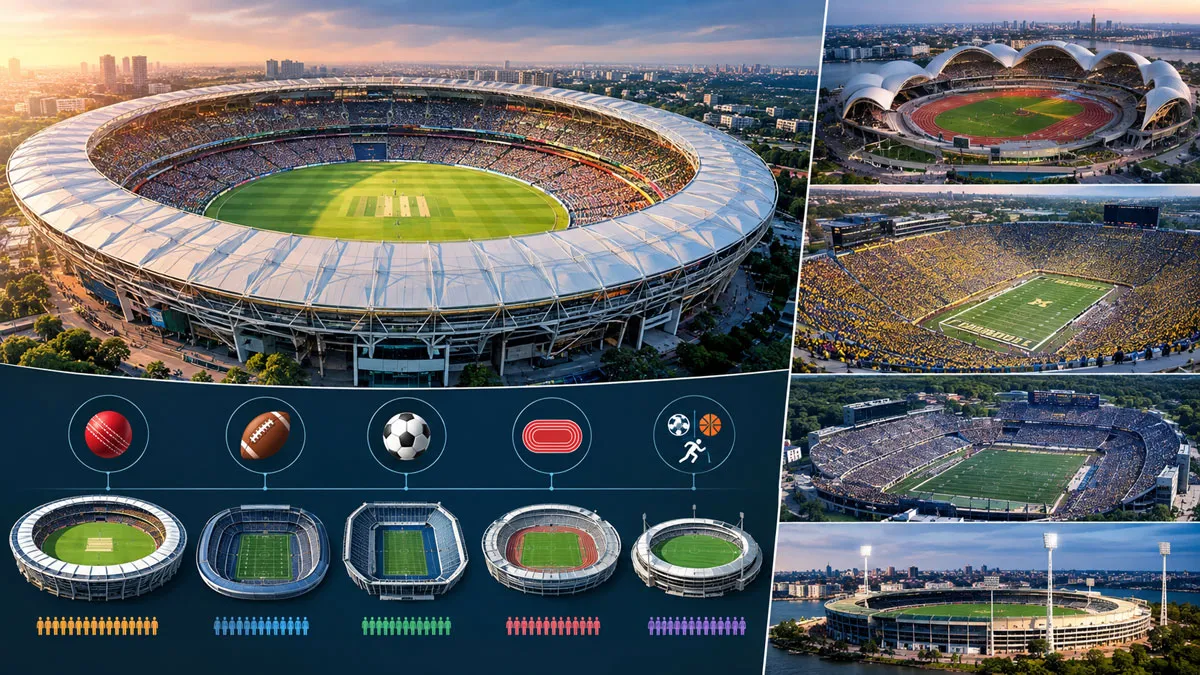
Stadiums are among the most ambitious structures built for sport, bringing tens of thousands of spectators together around a single field, pitch, or track. Their scale varies considerably by sport, region, and design, but a small group of venues stands out for having exceptionally large published capacities.
Capacity is the most practical way to compare stadium size, although figures can differ according to seating configuration, standing areas, event requirements, and renovations. The venues below therefore focus on established published capacities rather than temporary attendance arrangements.
The Largest Stadiums By Published Capacity
| Stadium | Location | Primary Sport Or Use | Published Capacity |
|---|---|---|---|
| Narendra Modi Stadium | Ahmedabad, India | Cricket | 132,000 |
| Rungrado 1st of May Stadium | Pyongyang, North Korea | Football and multi-purpose events | 113,281 |
| Michigan Stadium | Ann Arbor, United States | American football | 107,601 |
| Beaver Stadium | University Park, United States | American football | 106,572 |
| Melbourne Cricket Ground | Melbourne, Australia | Cricket and Australian rules football | 100,024 |
These figures illustrate an important feature of the world’s largest stadiums: American college football, cricket, and multi-purpose sporting events dominate the highest-capacity venues. Large association-football stadiums are internationally famous, but they do not necessarily have the same seating capacity as the biggest cricket and college-football grounds.
Narendra Modi Stadium
Located in Ahmedabad, India, the Narendra Modi Stadium is the largest venue in this comparison, with a published capacity of 132,000 spectators. It is primarily a cricket stadium and is operated by the Gujarat Cricket Association.
The present stadium was developed through a major reconstruction of the former Motera cricket ground and opened in its modern form in 2020. Its enormous capacity reflects the popularity of cricket in India and the demand for large venues capable of accommodating major domestic and international matches.
The stadium is designed specifically around cricket, with a large playing area and extensive spectator facilities. Its scale also allows it to host events beyond regular cricket fixtures, making it an important example of how modern sports architecture can combine very high capacity with multiple functions.
Rungrado 1st of May Stadium
The Rungrado 1st of May Stadium stands on Rungra Island in Pyongyang, North Korea. Its published capacity is approximately 113,281 people, placing it among the largest stadiums ever built.
Opened in 1989, the stadium has a distinctive roof formed by multiple curved sections that resemble flower petals. Its design gives the building a recognizable silhouette while covering much of the spectator area.
Unlike a conventional single-sport arena, the venue has been used for football, athletics, ceremonies, and large-scale performances. This multi-purpose role is significant when comparing stadiums because capacity alone does not explain how a venue is designed or how its space is used.
Michigan Stadium
Michigan Stadium in Ann Arbor, Michigan, is one of the world’s largest stadiums devoted primarily to American football. Known as “The Big House,” it has an official capacity of 107,601.
The stadium opened in 1927 and was originally designed for a much smaller audience. Successive expansions increased its capacity over many decades, reflecting the unusually strong attendance culture associated with college football in the United States.
Its enormous size is particularly notable because the stadium is primarily associated with a university sports program rather than a national team or professional franchise. The venue has also hosted sporting events outside American football, including hockey and soccer matches.
Why Michigan Stadium Became So Large
The stadium’s growth was closely connected to sustained demand for Michigan football. Instead of replacing the original facility with a completely new stadium, the University of Michigan expanded and modified the existing structure repeatedly.
This approach demonstrates how some of the world’s largest stadiums reached their present dimensions gradually. Their size is not necessarily the result of a single construction project; it can also reflect decades of expansion, changing spectator expectations, and the popularity of the sport.
Beaver Stadium
Beaver Stadium is the home of Penn State football in University Park, Pennsylvania. Its published capacity is 106,572, making it one of the largest college-football stadiums in the world.
The stadium opened in 1960 after Penn State’s previous football facility was dismantled and relocated to the university’s east campus. It originally accommodated far fewer spectators than it does today, but successive expansions transformed it into a huge horseshoe-shaped venue.
Beaver Stadium illustrates another recurring pattern among very large sports venues: the stadium’s capacity developed alongside the growth of its sporting program and its ability to attract exceptionally large home crowds.
Melbourne Cricket Ground
The Melbourne Cricket Ground, commonly known as the MCG or “the G,” is one of Australia’s most important sporting venues. Its published total capacity is 100,024, including approximately 95,000 seats and additional standing space.
Opened in 1853, the MCG is considerably older than most of the other stadiums in this group. It has been associated with cricket and Australian rules football for generations and has also hosted major international sporting events.
The venue’s history demonstrates that extraordinary stadium capacity does not always depend on modern construction. The MCG has reached its current scale through extensive redevelopment while retaining its role as a major sporting landmark.
Why Stadium Capacity Varies
A stadium’s advertised capacity should not automatically be interpreted as the number of people who can attend every type of event. Different sports require different layouts, safety arrangements, media facilities, player areas, and circulation space.
- Sport configuration: The same venue may use different seating arrangements for different sports.
- Seated versus standing capacity: Some published totals include designated standing areas, while others focus mainly on seats.
- Accessibility requirements: Accessible seating and wider circulation routes can affect the number of conventional seats.
- Event design: Concert stages, temporary structures, security zones, and technical equipment can reduce the available spectator area.
For that reason, a stadium’s official capacity is best understood as a figure rather than a guarantee that exactly the same number of spectators can attend every event.
How Different Sports Shape Giant Stadiums
The world’s largest stadiums reveal significant differences between sports. Cricket grounds often use broad oval layouts that can accommodate very large spectator bowls. American football stadiums typically emphasize steep, continuous seating around a comparatively compact rectangular field. Multi-purpose venues must balance the requirements of several activities.
These differences influence not only capacity but also sightlines, entrances, concourses, roof structures, playing surfaces, and the relationship between spectators and the field.
The concentration of extremely large venues in cricket and American college football is also linked to the way those sports developed their spectator traditions. In some regions, universities or national sporting institutions became major gathering points, creating long-term demand for exceptionally large grounds.
What Makes A Stadium Truly Exceptional
Capacity is an easy way to identify the largest stadiums, but it is only one measure of scale. A stadium can be historically important, architecturally distinctive, or highly versatile without having the world’s largest seating figure.
The most remarkable venues tend to combine several characteristics:
- Very high spectator capacity.
- A design suited to the primary sport.
- Long-term use for major sporting events.
- Infrastructure capable of moving large crowds efficiently.
- A strong connection with the sporting culture of its region.
For this reason, the world’s biggest stadiums are more than oversized seating bowls. They are large-scale public spaces shaped by sport, architecture, engineering, and the traditions of the communities that use them.