
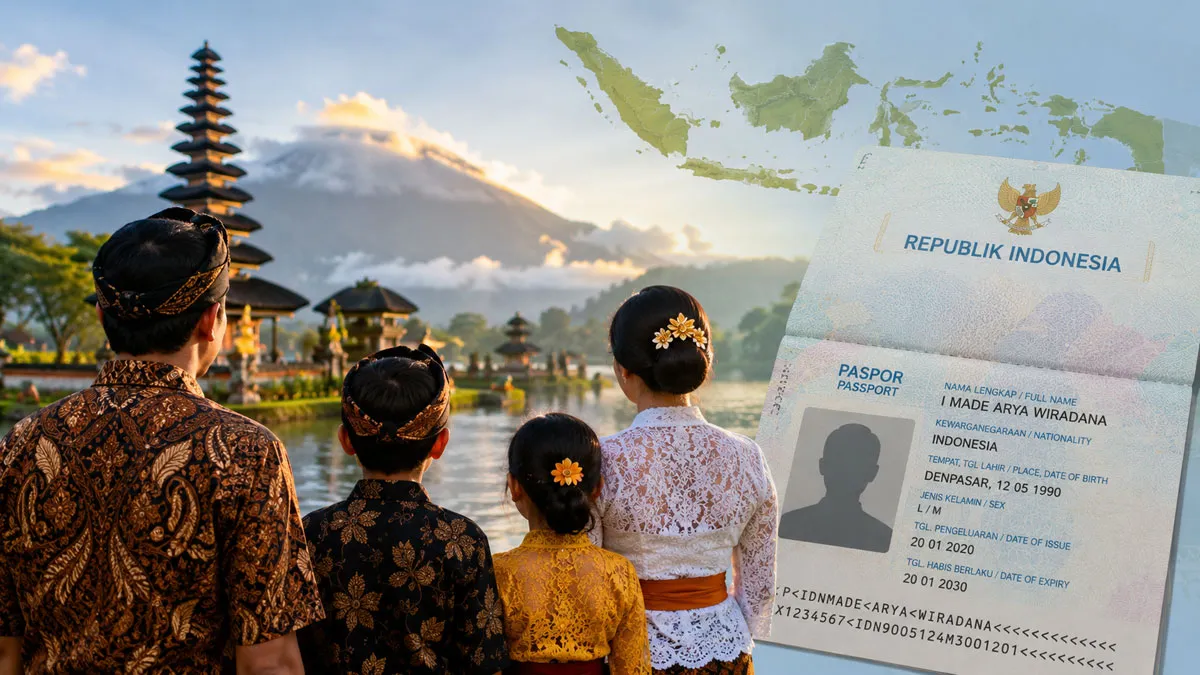
The idea that Indonesians have “no surnames” is partly true, but it is too broad to describe Indonesia as a whole. Indonesia is home to many ethnic groups, and their naming traditions differ considerably. In some communities, a hereditary family name is an important part of a person’s identity. In others, people traditionally use personal names without a fixed surname passed from one generation to the next.
This difference can be especially noticeable to people accustomed to Western-style naming systems, where a family surname normally identifies several generations of relatives. In Indonesia, however, a person’s final name element does not necessarily function as a surname. Understanding this distinction makes Indonesian names much easier to interpret.
Why Some Indonesians Do Not Have A Family Surname
There is no single Indonesian naming system. Personal names have developed through local cultures, languages, religions, and family traditions. Academic research on Javanese names, for example, describes a naming tradition in which hereditary surnames are not a defining feature. Names can instead consist of one or several personal elements whose meanings relate to family hopes, religion, cultural traditions, or circumstances surrounding a person’s birth.
This means that two people with completely different names may still be siblings, while two people who share a similar final name may have no family relationship at all. A name that appears to be a surname to a Western reader may simply be another part of the individual’s given name.
Javanese naming practices have also changed over time. Research based on Indonesian administrative name data has documented shifts in the vocabulary used for personal names, including increasing use of Arabic and English elements among more recent generations. This illustrates why Indonesian naming cannot be reduced to one traditional pattern.
Indonesia Has Both Surnames And Non-Surname Naming Traditions
Some Indonesian ethnic communities have well-established hereditary family names or clan names. Batak naming traditions, for example, include clan names that can identify a person’s family lineage. Other communities, including many Javanese families, have traditionally used personal names without a hereditary surname.
Consequently, it is more accurate to say that Indonesia does not have one universal surname system than to say that Indonesians do not have surnames.
| Naming Pattern | How It May Function |
|---|---|
| Single personal name | The entire name may be an individual’s personal name rather than a given name plus surname. |
| Multiple personal names | Several elements may form one personal name without the final element being a hereditary surname. |
| Family or clan name | A hereditary name may identify family or clan connections in some ethnic traditions. |
| Patronymic or inherited element | A name may indicate a relationship to a parent or ancestor without functioning exactly like a Western surname. |
Javanese Names Show Why The Surname Question Is Complicated
Javanese naming is one of the clearest examples of why Indonesian names should not automatically be interpreted through Western conventions. Historical and contemporary research describes Javanese personal names as a changing cultural practice rather than a rigid first-name-and-surname system.
Traditional Javanese names could be relatively short, including single personal names. Other names could contain several elements. Those elements might express aspirations for a child, religious influences, cultural associations, or other meanings. Modern naming has introduced additional patterns, including names influenced by Arabic and foreign languages.
A Name Ending Does Not Automatically Mean “Surname”
Suppose an Indonesian person is called “Budi Santoso.” A reader familiar with Western naming conventions might assume that “Santoso” is the family surname. That conclusion cannot be made from the name alone. “Santoso” may simply be part of the individual’s personal name.
The same principle applies when an Indonesian name contains three or more words. The final word is not automatically a surname simply because it appears in the position where a surname would normally appear in English-speaking countries.
Some Indonesian Names Do Identify Family Or Clan Connections
Indonesia’s ethnic diversity means that hereditary names are present in several communities. In these traditions, a family or clan name can carry information about ancestry and social identity.
It is therefore important to distinguish between the absence of a universal national surname convention and the absence of family names altogether. The former describes Indonesia much more accurately; the latter does not.
- Some Indonesians have hereditary family or clan names.
- Some have personal names without a hereditary surname.
- Some names contain elements connected with parents or ancestors.
- Some families use naming practices that have changed substantially across generations.
How Indonesian Official Documents Treat Names
Indonesian civil-registration rules also demonstrate that a family name is not a universal requirement for every Indonesian name. The country’s regulation on names in population documents permits a marga, family name, or another equivalent name to be included, rather than establishing one mandatory surname structure for everyone.
The regulation sets requirements for names recorded in population documents, including the use of Latin letters according to Indonesian language conventions and restrictions concerning abbreviations, numbers, and punctuation. It also establishes a minimum number of words for names recorded in these documents.
These administrative rules should not be confused with a cultural requirement that every Indonesian person must have a Western-style surname. Instead, they provide a framework for recording the diverse names used by the population.
Why Indonesian Names Can Be Misunderstood Internationally
International forms often assume that every person has both a given name and a family name. That assumption can create problems when applied to Indonesian names.
A person whose official name consists of one personal name does not necessarily have a missing surname. Likewise, someone with several words in their name does not necessarily have a separate family name at the end.
This distinction matters when names are entered into databases, airline reservations, academic records, banking systems, or other forms that divide a name into “first name” and “last name.” The correct interpretation depends on the individual’s actual legal and cultural naming structure rather than on the position of a word in an unfamiliar form.
So, Do Indonesians Have No Surnames?
No—not as a general rule. Indonesians have diverse naming traditions, and many people do not use a hereditary surname in the way commonly expected in Western countries. At the same time, hereditary family and clan names are an established part of naming traditions among some Indonesian communities.
The most accurate description is that Indonesia has no single nationwide surname tradition that applies uniformly to everyone. A person’s name may consist of a single personal name, several personal-name elements, a family name, a clan name, or another culturally meaningful combination.
Once this distinction is understood, Indonesian names become less mysterious: what may look like a missing surname is often simply a different way of organizing personal and family identity.