
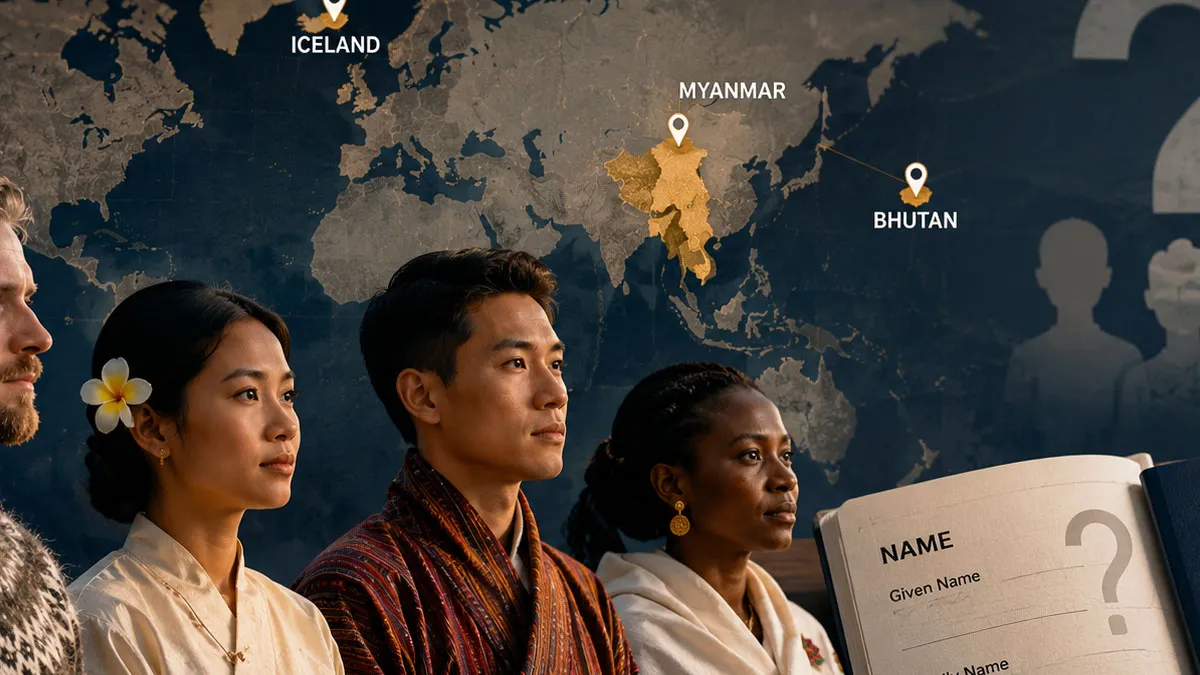
The idea of a surname is familiar in many parts of the world: a person has a given name followed by a family name that is shared across generations. However, this is not a universal naming pattern. In some societies, people traditionally use a personal name together with a parent’s name, while others have naming systems in which inherited family names are uncommon or absent.
There is therefore no simple list of countries where nobody has a surname. Naming customs can differ between ethnic groups, regions, religions, and families within the same country. Some countries are better described as having populations or traditional naming systems that do not normally use inherited surnames.
Countries Where Inherited Family Surnames Are Uncommon
| Country | Traditional Naming Pattern | Important Distinction |
|---|---|---|
| Iceland | Patronymic or matronymic names | Inherited family names exist but are uncommon |
| Malaysia | Many Malays use a personal name followed by the father’s name | Malaysia has several ethnic naming traditions |
| Indonesia | Some ethnic groups traditionally use personal names without family surnames | Naming practices vary considerably between communities |
| Myanmar | Burmese naming traditionally does not rely on inherited family surnames | Other ethnic groups in the country may use different systems |
Iceland
Iceland is one of the clearest examples of a society where the conventional inherited surname is not the normal pattern. A person’s final name often identifies their relationship to a parent rather than membership in a multigenerational family surname.
Traditionally, a child’s name may be formed from the given name of the father or mother combined with a gendered ending. The endings -son and -dóttir broadly indicate “son” and “daughter.” A person’s name can therefore change from one generation to the next rather than remaining the same family name.
This also means that siblings can have different last names. For example, one sibling may have a name based on the father’s given name while another may have a name based on the mother’s given name. Icelandic law also permits certain inherited family names, so describing Iceland as a country with “no surnames” would be too absolute.
Malaysia
Malaysia illustrates why nationality alone cannot always explain naming customs. The country is home to several major communities with different traditions. Among Malays, an inherited Western-style family surname is traditionally not used in the same way it is in many European and American naming systems.
A Malay name can include a personal name followed by the father’s name. The terms bin and binti traditionally indicate “son of” and “daughter of.” The father’s name in such a construction should not automatically be interpreted as a hereditary surname.
Other Malaysian communities use different naming structures. Chinese Malaysians, for example, commonly use a family name, while Indian and other communities may follow their own conventions. Consequently, Malaysia should not be described as a country in which surnames are universally absent.
Indonesia
Indonesia has one of the world’s most diverse naming landscapes, so a single national rule does not adequately describe how Indonesians are named. In some communities, particularly among many Javanese and Balinese people, inherited family surnames have traditionally been uncommon.
Many Indonesian personal names can therefore consist of one or more given-name elements without a hereditary surname. At the same time, other Indonesian communities have long-established family names, clan names, or hereditary titles. For this reason, Indonesia is better understood as a country with multiple naming traditions rather than as a country without surnames.
Myanmar
Traditional Burmese naming provides another important example. Burmese names do not generally follow the European model in which a hereditary family surname is passed unchanged from parents to children.
A Burmese personal name can contain several elements, and honorifics may also be used according to age, gender, or social context. Elements within a person’s name should therefore not automatically be interpreted as a family surname.
Myanmar is ethnically diverse, however, and some communities have their own naming traditions, including systems involving clan or family names. The absence of a conventional surname in traditional Burmese naming should therefore not be generalized to every person in the country.
Why Some Cultures Do Not Need a Hereditary Surname
A surname is only one possible way of identifying a person and connecting them to their family. Different societies have developed other methods that can serve similar purposes.
Several naming principles can appear instead:
- Patronymics: a name identifies a person’s father or another male ancestor.
- Matronymics: a name identifies the person’s mother or another female ancestor.
- Personal names: a person may have one or more given names without an inherited family name.
- Clan or lineage names: identity may be associated with a wider social group rather than a surname shared by every immediate family member.
These systems can perform some of the same social functions as surnames while following very different rules. A name that appears to be a “last name” when written in a Western-style form may actually describe a parent, ancestor, place, occupation, clan, or another relationship.
What Is the Difference Between a Surname and a Patronymic?
The distinction is particularly important when comparing international names. A surname normally refers to a family name that is inherited across generations. A patronymic, by contrast, is derived from a parent’s name and can change from one generation to another.
Suppose a father is named Erik and his son receives a name meaning “Erik’s son.” If the son’s own child later receives a name based on the son’s first name, the second-generation name will be different. The naming element is therefore genealogical, but it is not functioning as a permanent family surname.
Iceland provides a particularly clear example of this distinction. The fact that a person has a second name after their given name does not necessarily mean that the second name is a hereditary surname.
Why “No Surnames” Can Be Misleading
The phrase can create several misunderstandings. First, countries rarely have one naming tradition shared by every citizen. Ethnic and cultural diversity can produce several systems within the same national borders.
Second, legal documents and international databases often require fields such as “given name” and “family name.” A person whose culture does not traditionally use a hereditary surname may consequently encounter administrative systems designed around a different naming model.
Third, some people and families voluntarily adopt or retain hereditary family names even where the traditional system does not require them. Historical migration, marriage, international education, and contact with other naming cultures can all contribute to variation.
Countries With Nontraditional Surname Systems at a Glance
The most accurate way to summarize the situation is to distinguish between countries where hereditary surnames are unusual and countries where they are simply not universal.
| Naming Situation | Example |
|---|---|
| Inherited family names are uncommon for much of the population | Iceland |
| A major population traditionally uses parental names instead of Western-style surnames | Malaysia |
| Some large ethnic communities traditionally do not use inherited surnames | Indonesia |
| The dominant traditional naming system does not generally use hereditary surnames | Myanmar’s Burmese population |
How to Understand a Name Without a Surname
When encountering a name from a different cultural system, it is safer not to assume that the final element is a family name. The position of a name in a written form does not necessarily reveal its function.
Instead, consider the naming tradition behind it. A second name might identify a parent, while several name elements might collectively form one personal name. In other cases, a hereditary family name may exist but follow a cultural convention that differs from the format familiar to English-speaking readers.
Ultimately, there are countries and communities where inherited surnames are not the traditional norm, but there are very few cases where it is accurate to say that an entire modern country simply has no surnames. Iceland, Malay naming traditions in Malaysia, several Indonesian communities, and traditional Burmese naming demonstrate different ways societies can organize personal identity without relying on a permanent family surname.